– CURA CATOLICO HABLA EN CUBA: “PARA 2025, QUIEN NO CAMBIE SE EXTINGUIRA”. PHOTOS. * CATHOLIC PRIEST SPEAKS IN CUBA: “BY 2025, WHO DOES NOT CHANGE WILL BECOME EXTINCT.” PHOTOS.

CURA CATOLICO HABLA EN CUBA: “PARA 2025, QUIEN NO CAMBIE SE EXTINGUIRA”. PHOTOS.

El cura católico Leandro NaunHung instó a los cubanos a abrazar la resiliencia ante la crisis, destacando la necesidad de cambio, solidaridad y creatividad para sobrevivir los tiempos difíciles que se avecinan.


SANTIAGO DE CUBA- Un cura católico de Santiago de Cuba compartió en las redes sociales un video en el que reflexiona sobre la crisis actual en la isla, destacando la importancia de la resiliencia y el cambio como respuesta a las adversidades.

En su mensaje, Leandro NaunHung llamó a sus feligreses a no caer en la resistencia pasiva y aseguró que, en 2025, quien no cambie se extinguirá, subrayando la necesidad de adaptación ante los tiempos difíciles que se avecinan.

En el video, el sacerdote aborda el sentimiento de desesperación que invade a muchos cubanos, especialmente durante las noches sin electricidad: “Te da un deseo de llorar porque tú dices, ¿hasta cuándo, tanto sufrimiento inútil?”.

A pesar de ello, anima a la comunidad a encontrar la paz y la alegría en medio de las adversidades, recordando el anuncio de la Navidad como un llamado a la esperanza y a la preparación espiritual.

El cura hizo énfasis en la resiliencia como la clave para superar las dificultades, diferenciándola de la resistencia que, según él, lleva al agotamiento: “Resistencia lleva al final a explotar… No se trata de resistir, sino de cambiar”.

Llamó a la comunidad a unirse, a apoyarse mutuamente y a buscar nuevas formas de salir adelante, desde intercambiar bienes básicos hasta aprovechar oportunidades para generar ingresos en medio de la crisis.

“Resiliencia significa ser capaz de cambiar en medio de la adversidad y encontrar nuevas formas para seguir viviendo, porque nadie tiene derecho a matarme la vida”, afirmó NaunHung, mientras hacía un llamado a no dejarse engañar por quienes piden paciencia mientras disfrutan de privilegios.

En su intervención, también recordó las lecciones del llamado “Período Especial”, donde muchos cubanos aprendieron a adaptarse con creatividad a pesar de las carencias extremas.

Sin embargo, advirtió sobre los límites de la resistencia, mencionando que la capacidad de “aguantar” tiene un costo emocional y físico que no se puede ignorar: “Aguantar por aguantar no es vivir; es aceptar que otros te roben la vida”.

NaunHung también subrayó la importancia de la solidaridad entre vecinos y creyentes, animándolos a apoyarse en comunidad para sobrevivir, y habló de soluciones prácticas, como sembrar para generar ingresos o compartir alimentos básicos.

Este enfoque práctico y comunitario, dijo, es una manera de recuperar la dignidad y la independencia frente a las dificultades.

Preguntas frecuentes sobre la resiliencia y la crisis en Cuba según el cura Leandro NaunHung

¿Qué mensaje transmite el cura Leandro NaunHung sobre la situación en Cuba?

El cura Leandro NaunHung destaca la importancia de la resiliencia y el cambio como respuesta a la crisis en Cuba. En su mensaje, llama a no caer en la resistencia pasiva y a adaptarse a las adversidades para sobrevivir. También subraya la necesidad de la solidaridad y el apoyo comunitario para enfrentar los difíciles tiempos que se avecinan.

¿Cómo propone Leandro NaunHung enfrentar la crisis alimentaria en Cuba?

Leandro NaunHung sugiere soluciones prácticas como el cultivo de alimentos y la preparación de recetas de supervivencia. También anima a la comunidad a reciclar latas de aluminio para generar ingresos y fomentar la autosuficiencia alimentaria mediante métodos tradicionales como la conservación de alimentos con sal.

¿Qué rol juega la comunidad en la visión del sacerdote NaunHung para superar la crisis?

La comunidad es fundamental en la visión de NaunHung para superar la crisis en Cuba. Él enfatiza la importancia de la solidaridad, el apoyo mutuo y las iniciativas comunitarias para enfrentar las adversidades. Propone acciones como compartir alimentos y organizar comedores misioneros para ayudar a los más necesitados.

¿Qué lecciones del pasado menciona NaunHung para enfrentar la situación actual en Cuba?

NaunHung recuerda las lecciones del “Período Especial” en Cuba. Durante ese tiempo, los cubanos aprendieron a adaptarse con creatividad a pesar de las carencias extremas. Estas experiencias pasadas son utilizadas por el sacerdote para motivar a la comunidad a buscar nuevas formas de superar la crisis actual.


CATHOLIC PRIEST SPEAKS IN CUBA: “BY 2025, WHO DOES NOT CHANGE WILL BECOME EXTINCT.” PHOTOS.

Catholic priest Leandro NaunHung urged Cubans to embrace resilience in the face of the crisis, highlighting the need for change, solidarity and creativity to survive the difficult times ahead.

SANTIAGO DE CUBA – A Catholic priest from Santiago de Cuba shared a video on social media in which he reflects on the current crisis on the island, highlighting the importance of resilience and change as a response to adversity.

In his message, Leandro NaunHung called on his parishioners not to fall into passive resistance and assured that, in 2025, whoever does not change will become extinct, stressing the need for adaptation in the face of the difficult times ahead.

In the video, the priest addresses the feeling of desperation that invades many Cubans, especially during nights without electricity: “You feel like crying because you say, how long, so much useless suffering?”

Despite this, he encourages the community to find peace and joy in the midst of adversity, recalling the Christmas announcement as a call to hope and spiritual preparation.

The priest emphasized resilience as the key to overcoming difficulties, differentiating it from resistance, which, according to him, leads to exhaustion: “Resistance leads in the end to exploding… It is not about resisting, but about changing.”

He called on the community to unite, to support each other and to look for new ways to move forward, from exchanging basic goods to taking advantage of opportunities to generate income in the midst of the crisis.

“Resilience means being able to change in the midst of adversity and find new ways to continue living, because no one has the right to kill my life,” said Naun Hung, while calling for not being fooled by those who ask for patience while enjoying privileges.

In his speech, he also recalled the lessons of the so-called “Special Period,” where many Cubans learned to adapt creatively despite extreme shortages.

However, he warned about the limits of resistance, mentioning that the ability to “endure” has an emotional and physical cost that cannot be ignored: “Enduring for the sake of enduring is not living; it is accepting that others steal your life.”

Naun Hung also stressed the importance of solidarity among neighbors and believers, encouraging them to support each other in community to survive, and spoke of practical solutions, such as planting to generate income or sharing basic foodstuffs.

This practical and community approach, he said, is a way to regain dignity and independence in the face of difficulties.

Agencies/ CiberCuba/ CuraCubano/ Extractos/ Excerpts/ Internet photos/ Arnoldo VArona.

thecubanhistory.com
THE CUBAN HISTORY, HOLLYWOOD.

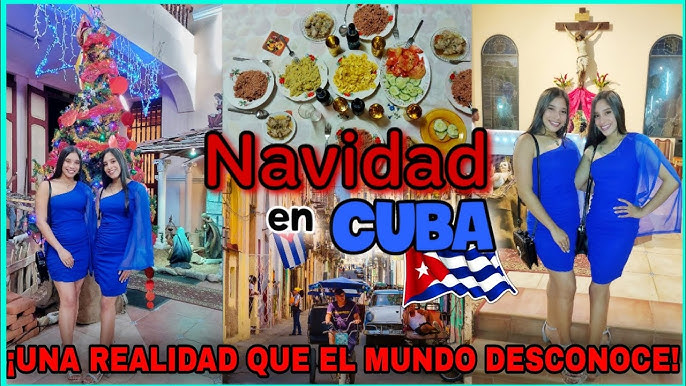
– LA NAVIDAD HASTA HOY EN LA ISLA CUBANA. SU HISTORIA. PHOTOS * CHRISTMAS UP TO TODAY ON THE CUBAN ISLAND, ITS HISTORY. PHOTOS.

LA NAVIDAD HASTA HOY EN LA ISLA CUBANA, SU HISTORIA. PHOTOS.

La historia de la Navidad en Cuba ha tenido varios siglos, dejando de celebrarse oficialmente durante el gobierno de Fidel Castro, entre 1969 y 1996.

El 320 d. C. el papa Julio I instauró la Navidad el 25 de diciembre.​ Tras la conquista del Imperio español de la isla de Cuba, los españoles evangelizaron a los habitantes en su fe, y comenzó a celebrarse la Navidad.

Durante el gobierno de Fidel Castro, el Estado se declaró ateo, y la Navidad era declarada día no laborable.

DESDE EL 1969 AL 1996

Fidel Castro en 1969. Ese año suspendió las celebraciones navideñas.
En enero de 1969, Castro celebró públicamente el décimo aniversario de su administración en la Plaza de la Revolución, aprovechando la ocasión para preguntar a la multitud reunida si tolerarían la reducción de las raciones de azúcar, lo que reflejaba los problemas económicos del país.​​ La mayor parte de la cosecha de azúcar se enviaba a la Unión Soviética, pero la cosecha de 1969 resultó gravemente dañada por un huracán; el gobierno anunció la suspensión de las celebraciones de la Navidad, Año Nuevo y Día de Reyes,​ posponiendo las vacaciones de Año Nuevo de 1969-1970 para alargar la cosecha.​ Los militares fueron reclutados, mientras que Castro y varios otros ministros del gabinete y diplomáticos extranjeros se unieron.​​ ​ La campaña fue conocida como la Zafra de los diez millones, sin embargo, el país no cumplió con la cuota de producción de azúcar de ese año.​

Después de que se dejase de celebrarse y promoverse la tradición navideña, la celebración más importante se convirtió en el 31 de diciembre, coincidente con el aniversario de la revolución. Adornos navideños continuaron apreciándose en los restaurantes, hoteles y comercios de venta en divisas extranjeras.

En 1995 el Partido Comunista emitió una circular en la que prohibía la exhibición de árboles de Navidad en lugares públicos que no fueran los frecuentados por turistas.

Según reportó el diario La Nación en 1997, «en los últimos años se ha hecho común la práctica de adornar el hogar ese día con el tradicional árbol de Navidad, muy costoso para la economía cubana».​

1997 HASTA EL PRESENTE

Celebración el día de la Nochebuena en Cuba.
El gobierno de Castro invitó al papa Juan Pablo II a la isla. La Iglesia católica cubana solicitó que la celebración de la Navidad se retomara oficial y permanentemente.​

El 13 de diciembre de 1997 Castro anunció que, como medida de «carácter excepcional»,​ con motivo de la visita del papa, que la Navidad era declarada día festivo.​

El 20 de diciembre se publicó en Granma un mensaje del papa, donde Juan Pablo II declaró que la Navidad era una tradición que estaba arraigada en el corazón de los cubanos.​ Esa visita de Juan Pablo II fue entendida como un espaldarazo a los católicos en el país.​ Ese año hubo celebraciones oficiales tras 28 años,​ pero La Nación reportó que «pocos estuvieron en condiciones de comprar un arbolito»; no hubo entregas oficiales de regalos.

Isidro Gómez, funcionario de la Oficina de Asuntos Religiosos del Partido Comunista, declaró en 1997 que habían sido abolidas las limitaciones para la colocación de árboles de Navidad en lugares públicos no frecuentados por turistas.​

En noviembre de 1998, el gobierno cubano autorizó la entrada a la isla de cuarenta sacerdotes, religiosos y religiosas extranjeros, entre ellos algunos de origen cubano, que iban con la intención de realizar su trabajo pastoral en distintas diócesis de la isla.​

El 1 de diciembre de 1998 el Buró Político del Partido Comunista decretó el día de Navidad como fiesta permanente en Cuba.

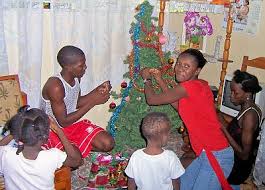
Actualmente la celebración de la Navidad ha ganado espacios,​ aunque habiendo al menos seis expresiones religiosas notables en Cuba, la relación entre sus creyentes con la Navidad es distinta.​ Son apreciables los árboles de Navidad y las imágenes de Santa Claus en los hogares y negocios privados.​


CHRISTMAS UP TO TODAY ON THE CUBAN ISLAND, ITS HISTORY. PHOTOS.

The history of Christmas in Cuba has lasted several centuries, ceasing to be officially celebrated during the government of Fidel Castro, between 1969 and 1996.

In 320 AD, Pope Julius I established Christmas on December 25. After the Spanish Empire conquered the island of Cuba, the Spanish evangelized the inhabitants in their faith, and Christmas began to be celebrated.

During Fidel Castro’s government, the State declared itself atheist, and Christmas was declared a non-working day.

FROM 1969 TO 1996

Fidel Castro in 1969. That year he suspended Christmas celebrations.
In January 1969, Castro publicly celebrated the tenth anniversary of his administration in the Plaza de la Revolución, using the occasion to ask the assembled crowd if they would tolerate reduced sugar rations, reflecting the country’s economic problems. Most of the sugar crop was shipped to the Soviet Union, but the 1969 harvest was severely damaged by a hurricane; the government announced the suspension of Christmas, New Year’s, and Three Kings’ Day celebrations, postponing the 1969–1970 New Year’s holiday to lengthen the harvest. The military was conscripted, while Castro and several other cabinet ministers and foreign diplomats joined in. The campaign was known as the Zafra of the Ten Million, however, the country failed to meet its sugar production quota for that year.

After the Christmas tradition was discontinued and promoted, the most important celebration became December 31, coinciding with the anniversary of the revolution. Christmas decorations continued to be seen in restaurants, hotels and shops selling foreign currency.

In 1995 the Communist Party issued a circular prohibiting the display of Christmas trees in public places other than those frequented by tourists.

According to the newspaper La Nación in 1997, “in recent years it has become common practice to decorate the home on that day with the traditional Christmas tree, which is very costly for the Cuban economy.”

1997 TO THE PRESENT

The Castro government invited Pope John Paul II to the island. The Cuban Catholic Church requested that the celebration of Christmas be officially and permanently resumed.

On December 13, 1997, Castro announced that, as a measure of “exceptional character”, on the occasion of the Pope’s visit, Christmas was declared a holiday.

On December 20, a message from the Pope was published in Granma, where John Paul II declared that Christmas was a tradition that was rooted in the hearts of Cubans. This visit by John Paul II was understood as a boost to Catholics in the country. That year there were official celebrations after 28 years, but La Nación reported that “few were able to buy a tree”; there were no official gift deliveries.

Isidro Gómez, an official of the Communist Party’s Office of Religious Affairs, declared in 1997 that restrictions on the placement of Christmas trees in public places not frequented by tourists had been abolished.​

In November 1998, the Cuban government authorized the entry to the island of forty foreign priests, religious men and women, including some of Cuban origin, who were going with the intention of carrying out their pastoral work in different dioceses on the island.​

On December 1, 1998, the Political Bureau of the Communist Party decreed Christmas Day as a permanent holiday in Cuba.

Currently, the celebration of Christmas has gained ground,​ although there are at least six notable religious expressions in Cuba, the relationship between its believers and Christmas is different.​ Christmas trees and images of Santa Claus are noticeable in private homes and businesses.​

Agencies/ Wiki/ NavidadCubanaHist. / Extractos/ Excerpts/ Internet Photos/ Arnoldo Varona.

thecubanhistory.com
THE CUBAN HISTORY, HOLLYWOOD.
– LA NOCHEBUENA CUBANA EN EL RECUERDO DE UN PASADO MEJOR. PHOTOS. * CUBAN CHRISTMAS EVE IN MEMORY OF A BETTER PAST. PHOTOS.

LA NOCHEBUENA CUBANA EN EL RECUERDO DE UN PASADO MEJOR. PHOTOS.

Las fiestas navideñas y de Año Nuevo son las celebraciones más esperadas cada año en la mayor parte del mundo. Se calcula que en unos 150 países, con mayor énfasis en los que están más arraigadas la tradición y la cultura cristianas. Y por lo general, la cena de Nochebuena, el 24 de diciembre, víspera de la Navidad, es el foco principal de dichas fiestas tradicionales en homenaje al nacimiento de Jesucristo. Lo es por su carácter familiar, a diferencia de la espera del Año Nuevo, que es una fiesta menos íntima, más pública y “callejera”.


En Cuba, luego de la introducción del ganado porcino, llevado por Colón al Caribe en su segundo viaje a “las Indias” (1493), poco después de la colonización de la Isla la carne de puerco se hizo indispensable en las grandes fiestas y muy particularmente en la Nochebuena, siguiendo la costumbre de esa celebración tradicional en España desde el siglo XVI.


En Cuba, se celebraba la Nochebuena y después se concurría a la Misa de Gallo. Pero a partir de 1969 las fiestas fueron eliminadas oficialmente y no fue hasta la visita del Papa Juan Pablo II y hasta diciembre de 1997, que se volvió a declarar el 25 de diciembre como día feriado no laborable. No obstante durante esos 28 años en muchos hogares cristianos se adoraba en la intimidad el nacimiento del Niño Jesús, y se recordaban a los Reyes Magos del Oriente.


Pero lo que si nunca dejó de celebrarse, de una u otra forma, fue la Nochebuena. Y los cubanos con esfuerzo, esa noche ponían en su mesa todo lo mejor que podían conseguir, que para eso estaba el mercado negro…

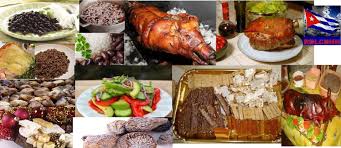
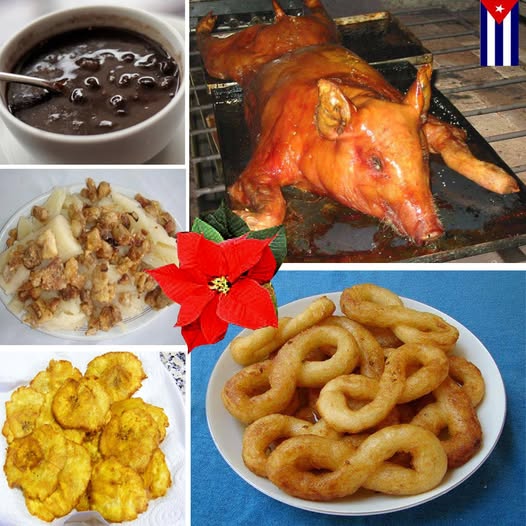
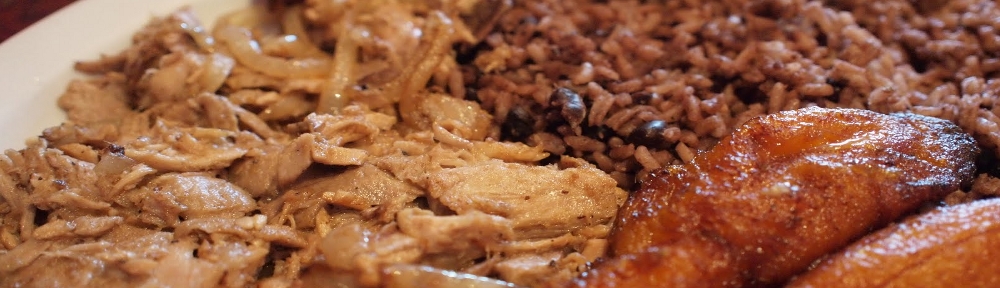
La comida tradicional de las mesas el 24 de diciembre era el lechón asado, arroz congrí o arroz y frijoles, viandas (yuca, malanga, boniato) con mojo criollo a base de naranja agria, grasa de puerco y mucho ajo. También acompañaban ensaladas o plátanos fritos maduros o verdes en versión de mariquitas o tostones. Los postres, algún que otro dulce en almíbar con queso criollo o los buñuelos, que con tanto esmero hacían nuestras abuelas, en forma de ocho, y que elaboraban a partir de una masa de harina, huevo y varios tubérculos. Al servirlos se bañaban con una almíbar hecha de azúcar y anís.


La fiesta comenzaba desde la noche del 23, cuando las madres adobaban el lechón y ponían en remojo los frijoles negros. En la mañana del 24, muy temprano, en el campo, o en casas con patio, se cocinaba al pincho o sobre un bastidor de metal improvisado. Se preparaba el “horno” en la tierra y se procedía al asado, ya fuese “al pincho” o sobre un bastidor de metal improvisado. El puerco se colocaba sobre una camada de hojas de guayaba, labor casi siempre a cargo del hombre de la casa y de los hijos varones. Y por supuesto acompañada esta labor por abundante cerveza.

EL LECHON, EL CENTRO DE LA COMIDA

El lechón era el anfitrión de la comida y cocinarlo era todo un ritual. Se asaba la pieza o el animal entero según eran las posibilidades económicas. Mientras se asaba, se untaba con mojo para que adquiriese ese sabor que cuesta olvidar. Ese adobo que permite el sabor y olor tan característico de la Nochebuena cubana. Y aunque cada familia poseía su «mojo especial», era común la naranja agria, especias y sal. Al menos yo no conozco mejor aliño que la tradicional mezcla de ajo y sal en el mortero, para tener al final esa pasta media blanca-amarillenta, y entonces sumarlo al jugo de la naranja agria con algo de pimienta negra molida y hojas de laurel…

En la parte occidental de la Isla, tenían un invento, «la caja cubana» y es una de las pocas formas de asado en que el carbón o braza va encima y no debajo de la carne, y ambos cerrados casi herméticos y mejor aun enterrados, y es también como mejor queda la piel del lechón y es algo para chuparse los dedos, por lo crujiente y suave de la piel al terminar.

En otros casos, el lechón era llevado a las panaderías, quienes por un mínimo precio, lograban en sus hornos una cocción perfecta. Aunque realmente el placer era hacerlo en casa y eso formaba parte de la tradición y la fiesta de ese día…

Las tradiciones Navideñas eran parte del patrimonio religioso y cultural de nuestro pueblo, y estaban arraigadas en su memoria histórica. Era la temporada festiva más esperada por los cubanos. Por su aceptación casi universal, la Navidad es la única celebración que impone normas idénticas a gentes de diversas culturas, idiomas y razas.
A pesar de la influencia norteamericana, la Navidad en Cuba se celebraba a la española, por la influencia de nuestros antepasados: con Nochebuena y los Tres Reyes Magos. Eran días mágicos de planeamiento; de compras de víveres y regalos para disfrutarlos con familiares y amigos; del envío de tarjetas postales; de la decoración festiva de nuestros hogares, tiendas, calles y ciudades, rebosantes de luces y colores.


La cena de Nochebuena era una de las fiestas familiares más importante del año, y sea una cena íntima entre pocas personas, o una enorme fiesta familiar, era una ocasión para reunir la familia, sentarnos juntos, conversar, vernos. Y eso recuerdos son imposibles de olvidar…

CUBAN CHRISTMAS EVE IN MEMORY OF A BETTER PAST. PHOTOS.

The Christmas and New Year holidays are the most anticipated celebrations every year in most of the world. It is estimated that in about 150 countries, with greater emphasis on those where Christian tradition and culture are more deeply rooted. And generally, Christmas Eve dinner, on December 24, Christmas Eve, is the main focus of these traditional celebrations in honor of the birth of Jesus Christ. It is so because of its family nature, unlike the wait for the New Year, which is a less intimate, more public and “street” celebration.

In Cuba, after the introduction of pigs, brought by Columbus to the Caribbean on his second voyage to “the Indies” (1493), shortly after the colonization of the Island, pork became indispensable in the great celebrations and particularly on Christmas Eve, following the custom of that traditional celebration in Spain since the 16th century.

In Cuba, Christmas Eve was celebrated and then people attended Midnight Mass. But from 1969 onwards the celebrations were officially eliminated and it was not until the visit of Pope John Paul II and until December 1997, that December 25 was again declared a non-working holiday. Nevertheless, during those 28 years in many Christian homes the birth of the Child Jesus was privately adored, and the Three Wise Men from the East were remembered.

But what never stopped being celebrated, in one way or another, was Christmas Eve. And the Cubans, with great effort, put on their tables that night the best they could get, because that’s what the black market was for…

The traditional food on the tables on December 24th was roast suckling pig, congrí rice or rice and beans, vegetables (cassava, malanga, sweet potato) with a Creole sauce made of sour orange, pork fat and lots of garlic. They also accompanied salads or fried ripe or green plantains in the form of mariquitas or tostones. The desserts were some sweets in syrup with Creole cheese or fritters, which our grandmothers made with such care, in the shape of an eight, and which they made from a dough of flour, egg and various tubers. When serving them, they were bathed in a syrup made of sugar and anise.

The party began on the night of the 23rd, when the mothers marinated the suckling pig and soaked the black beans. On the morning of the 24th, very early, in the countryside, or in houses with patios, the food was cooked on a skewer or on an improvised metal frame. The “oven” was prepared in the ground and the roasting was carried out, either “on a skewer” or on an improvised metal frame. The pig was placed on a layer of guava leaves, a task almost always carried out by the man of the house and the male children. And of course, this task was accompanied by abundant beer.

THE PIG, THE CENTER OF THE MEAL

The pig was the host of the meal and cooking it was a ritual. The whole piece or the entire animal was roasted depending on the economic possibilities. While it was roasting, it was covered with mojo so that it acquired that flavor that is hard to forget. That marinade that allows the flavor and smell so characteristic of Cuban Christmas Eve. And although each family had its “special mojo,” bitter orange, spices and salt were common. At least I don’t know of a better seasoning than the traditional mixture of garlic and salt in a mortar, to have that yellowish-white paste at the end, and then add it to the juice of the bitter orange with some ground black pepper and bay leaves…

In the western part of the Island, they had an invention, “the Cuban box” and it is one of the few ways of roasting where the charcoal or embers go on top and not under the meat, and both are almost hermetically sealed and even better buried, and it is also how the skin of the pig is best and it is something to lick your fingers, because of how crispy and soft the skin is when finished.

In other cases, the pig was taken to bakeries, who for a minimal price, achieved perfect cooking in their ovens. Although the real pleasure was to do it at home and that was part of the tradition and the celebration of that day…

Christmas traditions were part of the religious and cultural heritage of our people, and were rooted in their historical memory. It was the festive season most awaited by Cubans. Because of its almost universal acceptance, Christmas is the only celebration that imposes identical norms on people of different cultures, languages ​​and races.
Despite the North American influence, Christmas in Cuba was celebrated in the Spanish way, due to the influence of our ancestors: with Christmas Eve and the Three Wise Men. They were magical days of planning; of buying groceries and gifts to enjoy with family and friends; of sending postcards; of the festive decoration of our homes, stores, streets and cities, overflowing with lights.

Agencies/ Wiki/ NostalgiaCubana/ Derubin Jacome/ Roberto Alvarez/ Extractos/ Excerpts/ Arnoldo Varona.

TheCubanHistory.com
THE CUBAN HISTORY, HOLLYWOOD.