 FOLLOWING THE MUSICAL TRACK OF THE SENSATIONAL “LLOPIZ”. VIDEO.
Maybe they confused him with another tourist, in search of sex, rum and sun. But Carlos Pazos (Barcelona, 1949) snuck into Cuba with a subversive mission. Officially, he was invited to exhibit his pop art at the Center for the Development of Visual Arts in Havana.
Carlos Pazos slipped into Cuba with a subversive mission: to capture the footprints of Los Llopis, the first rock group in Spanish.
However, he had a personal obsession: to capture the tracks of Los Llopis, surely the first group that -in the mid-fifties- made rock and roll in Spanish.
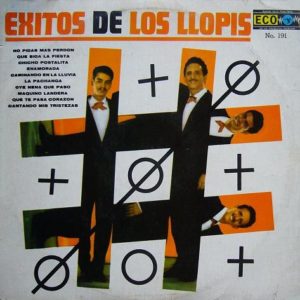
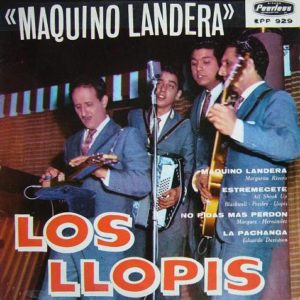
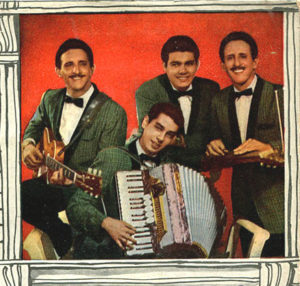
He knew it would be difficult. The Llopis triumphed on the powerful television of the Batista era. When Castro broke in, they went into exile in Spain, where they recorded and performed with remarkable success. That early desertion explains that hardly any of his remains are found in the current Cuba; In fact, in a history of island rock they are referred to as “Los Yopis”.
Pazos’ plan was ambitious. In Spain he had obtained funding for an artistic action, which would consist of forming a new Llopis, which he would present to the Havana public of 2011. And that is what is told in the DVD I invented some Llopis.
The documentary avoids detailing the agonies of Pazos. The National Library was under construction, the archives of the Cuban Radio and Television Institute were waiting for its digitalization; the peculiarities of Castroism even prevented placing advertisements soliciting interested musicians. He finally knocked on the doors of a conservatory, the Higher Institute of Arts, where he found students flexible enough to reproduce the repertoire of a group they had never heard of.
Havana lived up to its reputation as a magical city. The Viking appeared, a mature Norwegian musician married to a Cuban woman, who probably owned the only Hawaiian guitar in good condition on the Big Island. The Viking, by the way, did not want to wear a uniform.
Uniform? Of extranjis, Pazos had introduced enough cloth to dress his Llopis, with the complicity of a veteran tailor.
Much of I invented some Llopis reflects the pulse between Pazos and his mercenaries, reluctant to simplify their skills and play like that distant combo, which billed nice fashion rhythms in the fifties. The climax was missing: present your creature live. And there it collided with the government suspicion: that some transcripts of the Batistian television stars could be interpreted as nostalgia for that truculent Havana of vice and fun for gringos. And no, there was no way.
Until his Cuban friends taught him, as they say there, “solve”, depositing some bills in the right hands. Perfect, since the new Llopis played in a space that the old Llopis stepped on: the Copa Room, at the Riviera Hotel. Of course, tomorrow and without spectators: the concert was held behind closed doors, only for the cameras.
And what is left now of so much effort? The musicians returned to their studies, more interested in Latin jazz than in those rhythms of thin mustache. For Pazos, a mission accomplished, an immersion in an unrepeatable past. He confesses that he ended up burned: “I will never go back to Cuba, neither to those who now rule … nor to those who arrive later.”

 SIGUIENDO LA RUTA MUSICAL DE LOS SENSACIONALES “LLOPIZ”. VIDEO.
Tal vez le confundieron con otro turista más, en busca de sexo, ron y sol. Pero Carlos Pazos (Barcelona, 1949) se coló en Cuba con una misión subversiva. Oficialmente, estaba invitado a exponer su pop art en el Centro para el Desarrollo de las Artes Visuales habanero. Sin embargo, tenía una obsesión personal: captar las huellas de Los Llopis, seguramente el primer grupo que –a mediados de los cincuenta– hizo rock and roll en español.
Carlos Pazos se coló en Cuba con una misión subversiva: captar las huellas de Los Llopis, el primer grupo de rock en español.
Sabía que sería difícil. Los Llopis son ingenierías en Harvard– y triunfaron en la potente televisión de la era de Batista. Cuando irrumpió Castro, se exiliaron en España, donde grabaron y actuaron con notable éxito. Esa temprana deserción explica que apenas se encuentren rastros suyos en la Cuba actual; de hecho, en una historia del rock isleño se les menciona como “Los Yopis”.
El plan de Pazos era ambicioso. En España había conseguido financiación para una acción artística, que consistiría en formar unos nuevos Llopis, que presentaría ante el público habanero de 2011. Y eso es lo que se cuenta en el DVD Yo inventé unos Llopis.

El documental evita detallar las agonías de Pazos. La Biblioteca Nacional estaba de obras, los archivos del Instituto Cubano de Radio y Televisión esperaban su digitalización; las peculiaridades del castrismo hasta impedían colocar anuncios solicitando músicos interesados. Llamó finalmente a las puertas de un conservatorio, el Instituto Superior de las Artes, donde encontró estudiantes lo bastante flexibles para reproducir el repertorio de un grupo del que jamás habían oído hablar.
La Habana hizo honor a su reputación de ciudad mágica. Apareció El Vikingo, maduro músico noruego casado con una cubana, que poseía seguramente la única guitarra hawaiana en buen estado de la Isla Grande. El Vikingo, por cierto, no quería llevar uniforme.
¿Uniforme? De extranjis, Pazos había introducido suficiente tela para vestir a sus Llopis, con la complicidad de un sastre veterano.

Buena parte de Yo inventé unos Llopis refleja el pulso entre Pazos y sus mercenarios, renuentes a simplificar sus habilidades y tocar como aquel lejano combo, que facturaban simpáticos ritmos de moda en los cincuenta. Faltaba el clímax: presentar en directo a su criatura. Y allí colisionó con la suspicacia gubernamental: que actúen unos trasuntos de las estrellas de la televisión batistiana podía interpretarse como nostalgia por aquella truculenta Habana de vicio y diversión para gringos. Y no, no hubo forma.
Hasta que sus amigos cubanos le enseñaron a, como dicen allí, “resolver”, depositando unos billetes en las manos adecuadas. Perfecto, ya que los nuevos Llopis tocaron en un espacio que pisaron los viejos Llopis: el Copa Room, en el Hotel Riviera. Eso sí, de mañana y sin espectadores: el concierto se celebró a puerta cerrada, solo para las cámaras.
¿Y qué queda ahora de tanto esfuerzo? Los músicos volvieron a sus estudios, más interesados por el latin jazz que por aquellos ritmos de bigotito fino. Para Pazos, una misión cumplida, una inmersión en un pasado irrepetible. Confiesa que terminó quemado: “Nunca jamás volveré a Cuba, ni con los que ahora mandan… ni con los que lleguen luego”.
Agencies/EL Pais, Spain/Dario Manrique/YouTube/Internet Photos/ Arnoldo Varona/ TheCubanHistory.com
THE CUBAN HISTORY, HOLLYWOOD.