JACQUELINE ARENAL, FILM, TV ACTRESS. (Born: Havana).
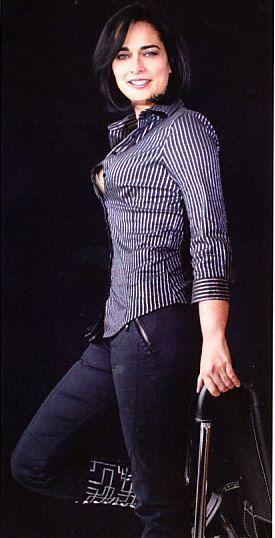
Jacqueline Arenal born in Havana, Cuba, April 10, 1968 as Diana Jacqueline Arenal Farré, is an actress with extensive participation in Cuban soap operas and movies.
For several years living in Colombia to which traveled by an employment contract with the Colombian channel RCN in which he has participated in soap operas have enjoyed acceptance of people also conquering the admiration and respect of the seers tele South American country with characters like Yoli de Los Reyes.
She is a graduate of action in the Superior Institute of Art in 1990. His parents are: Humberto Arenal writer and playwright and actress Martha Farré.
Spouse Enrique Carriazo
Son / s Camila Bordon Arenal
Among his most recent and best known performances are:
2015 the most holy – Candelaria Penagos
2014 The mother (soap opera) – Victoria Maldonado
2013-2014 Vampire Girl – Anne McLaren
Escobar 2012, the pattern of evil – Maruja Pachon
Agencies/Wiki/YouTube/InternetPhotos/Arnoldo Varona/TheCubanHistory.com
THE CUBAN HISTORY, HOLLYWOOD.
CUBA HOY/TODAY: Hermosa y bella playa de Guardalavaca.
JACQUELINE ARENAL, ACTRIZ DEL CINE Y LA TELEVISIÓN. (Nacida enLa Habana).
Jacqueline Arenal born in La Habana Cuba, 10 de abril de 1968 como Jacqueline Diana Arenal Farré, es una actriz con amplia participación en telenovelas y en el cine cubano.
Desde hace unos años reside en Colombia a la que viajó por un contrato de trabajo con el canal colombiano RCN en el que ha participado en telenovelas que han gozado de la aceptación del pueblo conquistando también la admiración y el respeto de los televidentes del país sudamericano con personajes como la Yoli de Los Reyes.
Es graduada de actuación en el Instituto Superior de Arte en 1990. Sus padres son: El escritor y dramaturgo Humberto Arenal Y la actriz Martha Farré.
Entre sus mas recientes y conocidas actuaciones están:
2015 Las Santísimas – Candelaria Penagos
2014 La suegra (telenovela) – Victoria Maldonado
2013-2014 Chica Vampiro – Ana McLaren
2012 Escobar, el patron del mal – Maruja Pachón
Agencies/Wiki/YouTube/InternetPhotos/Arnoldo Varona/TheCubanHistory.com
THE CUBAN HISTORY, HOLLYWOOD.
“EL CUBILETE” HOW TO PLAY THE POPULAR CUBAN DICE GAME. Photos.
Set Up.
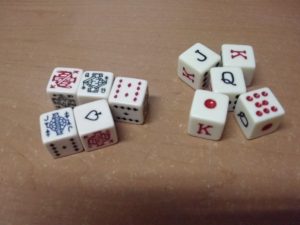
Each player rolls one cubilete. The player with the highest cubilete (A-K-Q-J-G-N in order of value) goes first.
Players take turns shaking the Cubilete cup and rolling out the dice. Each turn consists of as many as three rolls of the dice. After each roll, the player has an opportunity to take dice out of the cup and put them aside for his hand.
Players can stop rolling any time after the first roll, if they are satisfied with their hand. Patas (points) are scored and a running total kept for each player.
Once a player’s turn ends, the turn passes to the player on the left.
Cubilete bracelet
The object of the game is to roll five dice of the same kind. A hand with less than five of a kind has absolutely no value.
To win a round, you need to get the highest hand. The winner of each round (and only the winner) wins points based on the value of their hand. A game is played to a total score of 10 patas (points). Whoever gets 10 points first wins the game, even if all of the players have not had a turn.
The ultimate goal of the game is to score “Carabinas.” If you roll any Carabina during the game you immediately win the round and get to keep rolling for another round.
There are three types of Carabina, listed in order of value.
Carabina de Aces — is worth ten points and is very difficult to obtain. To get Carabina de Aces, you need to get a complete set of five aces within the three-roll limit. If you get Carabina de Aces, you are awarded 10 points. The game is over. You have eliminated everyone else in the game. You are the winner of the game, even if no one else had a chance to roll. If you get Carabina de Aces, then you are always the first roller in the next game.
Carabina de Ks (Kings) Naturales — you need to have five Kings within your three allotted rolls. If you get this type of Carabina, you get five points. You win the round, the round ends and you keep on rolling on to the next round.
Carabina de Ks (Kings) No Naturales — the only way to obtain this is by pairing the Aces with the Kings. (The Ace can be paired with any of the other dice because it is wild.) If you obtain this type of carabina, you get two points. You win the round, the round ends and you keep on rolling on to the next round.
If nobody gets a Carabina after everyone has had their turn, one point is awarded to the person with the highest hand:
· Five Queens
· Five Jevas (Jacks)
· Five Gallegos
· Five Blacks
On their first roll, Player One gets one King, one Ace, two Jacks, and a Gallego. Player One could decide to roll for all Aces, all Jacks, or all Kings. (With the Ace, they already have three Jacks or two Kings.)
If they do decide to keep the Jacks for example, they would set the two Jack dice and the ace aside and re-roll the remaining dice.
On their next roll, Player One gets one Queen and a Jack. Again, they would set the Jack aside and re-roll the Queen.
Now the final roll. If they are lucky, they get either an Ace or a Jack, and end up with five Jacks.
The turn passes to the player on the left. Player Two now knows that he or she must beat five Jacks to win the game. So this person obviously won’t try to roll for anything less than five Jacks.
Once the dice cup has gone around the table, and no Carabina has been scored, the player with the highest hand gets one point. The player that rolls last is the first player to roll in the new round.
The strategy in Cubilete is knowing what to play for and when, depending on what your opponents score. Obviously, luck is the dominant factor.
Cubilete is often played as a drinking game, with several scoring variations. However, in all variations, losers tend to pay for the winners drinks!
Agencies/ThreeCubanGuys/InternetPhotos/Arnoldo Varona/TheCubanHistory.com
THE CUBAN HISTORY, HOLLYWOOD.
CUBA PHOTOS.
“EL CUBILETE”, COMO JUGAR EL POPULAR ENTRETENIMIENTO CUBANO DE DADOS. FOTOS.
Cubilete es un juego antiguo y muy tradicional en Cuba, que es el segundo en popularidad al dominó cubano.
Todos, juegan de niños de escuela a viejas abuelas. Juegos de cubilete similares se reproducen en otros países de América Latina, pero las reglas varían en el mapa, con muchas culturas jugando una versión que es muy parecido al Juego de cartas Poker. Sin embargo el juego cubano es único.
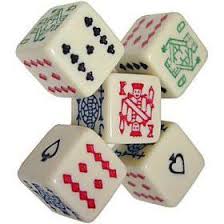
Hay cinco dados en el tradicional juego de Cubilete. Cada dado tiene seis lados y cada lado tiene uno de los siguientes caracteres en él:
El Cubilete
Inicialmente, cada jugador tira un dado. El que saque el mayor valor “pone tiro”. De haber empate se puede ir a una segunda vuelta.
El jugador que “pone tiro” puede tirar los dados hasta tres veces y seleccionar el grupo de caras (Ases, Reyes, Reinas, Jacks, Gallegos o Negros) que en su opinión sea más difícil de “matar”.
El turno al tiro rota por la mano derecha.
Los Ases sirven como comodines y pueden tomar el lugar de cualquier cara en un grupo.
El valor de la cara es: As, K, Q, J, 8, 7.
Se juega a 10 puntos.
Se le llama Carabina a la tirada 5 Ases o Reyes.
Una Carabina de Ases vale 10 punto y termina el juego.
Una Carabina de Reyes Natural (sin Ases) vale 5 puntos y termina la ronda.
Una Carabina de Reyes “sucia” (con Ases) vale 2 puntos y termina la ronda.
Si no se logra Carabina gana un punto el jugador con la tirada de más valor.
Cada jugador puede hacer tantas tiradas como el que originalmente “puso el tiro”
“Pone tiro” el jugador que gana el/los punto(s)
Agencies/ThreeCubanGuys/InternetPhotos/Arnoldo Varona/TheCubanHistory.com
THE CUBAN HISTORY, HOLLYWOOD.
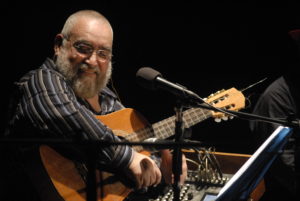
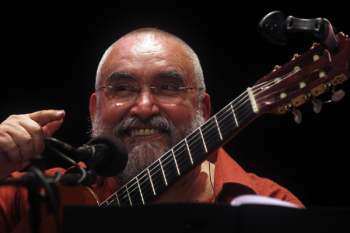
PEDRO LUIS FERRER, SINGER, SONGWRITER. (Born: Sancti Spiritus). VIDEOS.
Pedro Luis Ferrer is a guitarist, composer and singer.
Pedro Luis Ferrer Montes was born September 17, 1952 in Yaguajay, North of Sancti Spíritus, former province of Las Villas, in a family of devotees of poetry popular and festive. There is where part of the primary studies. It will then live in Havana and is in the sixth grade, trying to then repeatedly finished the first year of secondary Basic. We can say that he barely attended school.
His musical training is a sort of intuition and self-taught efforts which have enabled him to compose songs and guarachas pieces for guitar and various orchestral formats. He has composed preludes and fugues for piano. It cultivates the tenth, the sonnet, the redondilla and free poetry forms. In this sense it continues a family tradition learnt from his father Rodolfo and his uncle Raúl Ferrer, who continues with her daughter Lena Ferrer.
Still very young – in the mid-60 – began to be linked to small groups that unsuccessfully sought to become. Forming part of one of these groups – Quartet the Nova – known Carlos Alfonso (today director of the synthesis group) who learns and experiences by first time management of the voices and is contacted with updated sources of popular music.
At the end of the year 1969 he joined the Group given the Rock, experience shared with his teacher Alfredo Areas – and with Mike Pourcel, one of the most important troubadours of that time in Havana. He also thrives on the experience of Leopoldina Núñez and Victor Zayas, pianist who introduces you to the art of orchestration.
La trova
In 1973 he begins his career as a Troubadour and mid 70 recorded their first LP, “Pedro Luis Ferrer”. The song “Butterfly”, converted into a hymn in the voice of Miriam Ramos – Cuban singer of the Nueva Trova movement, and the “Romance of the bad girl” song – poem by Raúl Ferrer – stand out in this production, one of his best-known performances.
The eighties
In this decade created the Group and recorded two LP: “under my voice” and “Sand and foam”. This last disc released a group of guarachas that quickly became popular on the island, such as “Artificial insemination” and “how I like it ‘hablal’ Spanish.
These festive works as background had some songs of the 1970s as “Which does indeed serve the coat” and “Are esdrujula luck”. It is noteworthy in these years their relationship with the teacher Jesús Ortega, editor of one of his early works for the instrument “Guitar released”. In this period he made works for several documentaries and films of the film section of the FAR. In this decade he receives Máximo Gómez machete replica and performs with his group a short visit to the Republic of Angola; then he traveled again to Europe and Latin America.
The nineties
The 90 pass as a sort of furtive artistic life, however become popular – exchanging underground and spontaneous public – songs such as “Hundred by hundred Cuban”, “Marucha la Jinetera”, “Grandfather Paco”, “He has delusions of love boys”, “Friend drainer”, “Havana is populated by slogans”, “All the same”, “Chain of birds”, “The gentleman from Paris”, etc. Also heard on the radio and their songs in the voice of other interpreters, as it is the case of “Carapacho pa’ the turtle ‘.
Pedro Luis travelled several times to the United States and gives concerts in New Orleans and Miami. Publishes his first album abroad: “Cent by cent Cuban”. Then in Havana is published, without the consent of Pedro Luís and being treated as an artist already deceased, a disc with footage, recordings of the 80s, low title of “the best of Pedro Luís Ferrer”. She also made two tours of Germany.
The 2000
In 2005 he published his CD “Rustic”, and later “Natural”, two CD published by the label hidden from Ultra records, with materials from the personal archive of Pedro Luis, recorded and mastered by him in his modest personal Studio in Havana. Some of them were rewritten in part or full. Others were mixed again, keeping even tracks that could be bettered now, but who is wanted to keep intact for documentary and emotional reasons.
“Dissent is a natural Act and who see in it something wicked is sick. “In the same way, turn that into a hypertrophy and define itself, disagree or be dissident out a trade, as neither”, considers Pedro Luis on the eve of the concert which will be April 25 in Madrid to guitar clean a year after his last visit.
During a long, in the 1990s, Pedro Luis Ferrer was banned in official areas of Cuba and he organized in relief as a “tour of patios and rooftops of Havana”. Also, on occasion in Miami they have bothered with it by not feeding the anti-Castro speech use, but, he says, the consequences of “not being agreed” have never worried him.
His rebelliousness has always combined it with the pursuit of musical essences of Cuba and experimentation with traditional rhythms, some almost forgotten, such as the changüi or the nengón, and albums such as rustic or Natural have emerged out of this work. A treasure trove of Cuban music.
Agencies/Wiki/PLFVivo/InternetPhotos/Vicent/youtube/TheCubanHistory.com
THE CUBAN HISTORY, HOLLYWOOD.
CUBA PHOTOS. – Calles de la Habana, Manrique entre Laguna y San Lazaro.
PEDRO LUIS FERRER, CANTAUTOR. Nacido en Sancti Spiritus.VIDEOS.
Pedro Luis Ferrer es un guitarrista, compositor y cantante.
Pedro Luis Ferrer Montes nació el 17 de septiembre de 1952 en Yaguajay, al Norte de Sancti Spíritus, antigua provincia de Las Villas, en una familia de cultores de la poesía popular y festiva. Allí es donde realiza parte de los estudios primarios. Posteriormente va a vivir a La Habana y cursa el sexto grado, intentando luego varias veces terminar el primer año de secundaria básica. Podemos decir que apenas asistió a la escuela.
Su formación musical es una suerte de intuición y de empeño autodidacta que le han permitido componer desde canciones y guarachas hasta obras para guitarra y diversos formatos orquestales. Ha compuesto preludios y fugas para piano. Cultiva la décima, el soneto, la redondilla y formas libres de la poesía. En este sentido sigue una tradición familiar aprendida de su padre Rodolfo y su tío Raúl Ferrer, que continúa con su hija Lena Ferrer.
Siendo muy joven – a mediados de la década del 60 – comienza a vincularse con pequeños grupos que sin éxito intentaban profesionalizarse. Formando parte de uno de estos de estos grupos- el cuarteto Los Nova- conoce a Carlos Alfonso (hoy director del Grupo Síntesis) con quien aprende y experimenta por vez primera el manejo de las voces y se pone en contacto con fuentes actualizadas de la música popular.
A finales del año 1969 se integra al grupo de Rock Los Dada, experiencia que compartió con su maestro Alfredo Areas – y con Mike Pourcel, uno de los más importantes trovadores de esa época en la Habana. También se nutre de la experiencia de Leopoldina Núñez y de Victor Zayas, pianista que le introduce al arte de la orquestación.
La trova
En el año 1973 comienza su carrera profesional como trovador y mediados de 70 graba su primer LP “Pedro Luis Ferrer”. En esta producción se destacan la canción “Mariposa” , convertida en himno en la voz de Miriam Ramos – cantante cubana del movimiento de la Nueva Trova, y la canción “Romance de la Niña mala” – poema de Raúl Ferrer -, una de sus interpretaciones más conocidas.
Los ochenta
En esta década crea su grupo y graba dos LP: “Debajo de mi voz” y “Espuma y Arena”. Este último disco dio a conocer un grupo de guarachas que rápidamente se hicieron populares en la isla, como la “Inseminación artificial” y “Cómo me gusta ‘hablal’ español .
Estas obras festivas tenían como antecedentes algunas canciones de los años 1970 como “Al que le sirva el sayo” y “Son de la suerte esdrújula”. Es de destacar en estos años su relación con el maestro Jesús Ortega, editor de una de sus primeras obras para el instrumento “Guitarra Suelta”. En esta época realizó trabajos para algunos documentales y filmes de la entonces Sección Fílmica de las FAR. En esta década recibe la réplica del machete de Máximo Gómez y realiza con su grupo una breve visita a la República de Angola; luego viaja nuevamente a Europa y América Latina.
Los noventa
Los años 90 transcurren como una suerte de vida artística furtiva, no obstante se hacen populares – mediante el intercambio subterráneo y espontáneo del público – canciones como “Ciento por ciento cubano” , “Marucha la Jinetera”, “Abuelo Paco”, “Él tiene delirio de amar varones”, “Amigo Palero”, “La Habana está poblada de consignas”,”Todos por lo mismo”, “Cadena de pájaros”, “El Caballero de París”, etc. También se escuchan en la radio y sus canciones en la voz de otros intérpretes, como es el caso de “Carapacho pa’ la jicotea”.
Pedro Luis viaja varias veces a los Estados Unidos y da conciertos en Nueva Orleans y Miami. Publica en el exterior su primer disco : “Ciento por ciento cubano”. Acto seguido en la Habana se publica, sin el consentimiento de Pedro Luís y siendo tratado como un artista ya fallecido, un disco con material de archivo, grabaciones de los 80, bajo título de “Lo mejor de Pedro Luís Ferrer”. También realiza dos giras por Alemania.
Los 2000
En 2005 publica su CD “Rústico”, y más tarde “Natural”, dos CD publicados por el sello ESCONDIDA de Ultra records, con materiales de el archivo personal de Pedro Luis, grabados y masterizados por él en su modesto estudio personal de La Habana. Algunos de los mismos fueron regrabados en parte o completos. Otros, fueron mezclados nuevamente, manteniendo incluso pistas que podían ser superadas ahora, pero que se quisieron mantener intactas por razones documentales y afectivas.
“Disentir es un acto natural y el que vea en ello algo perverso está enfermo. Del mismo modo, convertir eso en una hipertrofia y autodefinirse por ello, como si disentir o ser disidente fuera un oficio, pues tampoco”, considera Pedro Luis en vísperas del concierto que dará el 25 de abril en Madrid a guitarra limpia un año después de su última visita.
Durante una época larga, en los noventa, Pedro Luis Ferrer estuvo prohibido en los espacios oficiales de Cuba y él mismo organizó en desagravio una “Gira por patios y azoteas de La Habana”. También, en alguna ocasión en Miami se han molestado con él por no alimentar el discurso anticastrista al uso, pero, dice, las consecuencias de “no estar de acuerdo” nunca le han preocupado.
Su rebeldía siempre la ha compaginado con la búsqueda de las esencias musicales de Cuba y la experimentación con ritmos tradicionales, algunos casi olvidados, como el changüí o el nengón, y de este trabajo han surgido discos como Rústico o Natural. Un tesoro de la música cubana.
Agencies/Wiki/PLFVivo/InternetPhotos/Vicent/youtube/TheCubanHistory.com
THE CUBAN HISTORY, HOLLYWOOD.


 JACQUELINE ARENAL, FILM, TV ACTRESS. (Born: Havana).