— HEMINGWAY AND COJIMAR, CUBA, where only Remain The Old and The Sea. + HEMINGWAY Y COJIMAR, CUBA, Donde Solo Quedan Lo Viejo y el Mar.

HEMINGWAY AND COJIMAR, CUBA, WHERE ONLY REMAIN THE OLD AND THE SEA.
By Luz Escobar, La Havana.
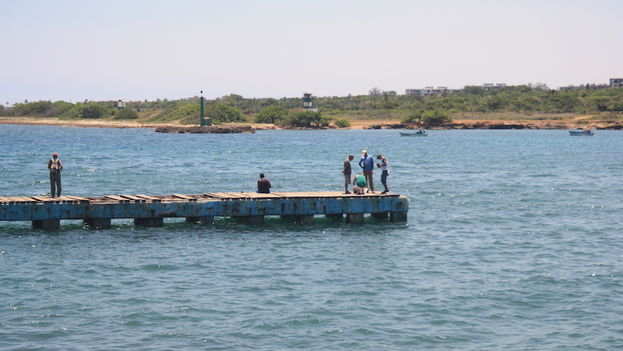
El embarcadero de Cojímar, donde ahora los pescadores hacen su labor con varas y cordel, la mayoría de ellos impedidos de tener una embarcación para salir al mar. (14ymedio)

The Jetty of Cojimar, where now the fishermen make their work with sticks and Twine, most of them not allowed to take a boat out to sea.

The Jetty of Cojimar, where now the fishermen make their work with sticks and Twine, most of them not allowed to take a boat out to sea. (14ymedio)

The bust of Ernest Hemingway, dotted with saltpeter, was smelted from keys, locks, old propellers of boats, chains and bronze screws. Objects collected by the famous writer friends and fishermen of Cojimar, a town that lives today reminded the author of ‘the old man and the sea’, already far from the epic of hooks and nets.

Tourists spend little time in this locality of the municipality of Havana from the East, just a few minutes. They come in looking for something that makes them revive the feat of the character of Santiago and its enormous fish, sharks devoured while she brought to the coast. They believe that you will find the entire population dumped into the surf and seafood, but they found an area absorbed by standardization and apathy that toured the country.

No signal indicates the site where stands the sculpture of the Nobel Prize for literature, performed by the artist Fernando Boada without charging a penny. Only the guides that show the site to foreigners and older residents make a stop opposite the monument. The locals have few visitors carried a photograph of the nearby bust of José Martí, thinking that it is the American writer.

Cojimar, Cuba.

Cojimar, Cuba.

Tourists believe that you will find the entire population dumped into the surf and seafood, but find an area absorbed by standardization and apathy that toured the country. Appointment with participating foreign, at the opposite end of Havana, has stolen the limelight to local competition and has resulted in a meeting full of resources and glamour. More than 100 boats that will compete, only three are Cubans, because, according to an employee of the exclusive marina, is a “very expensive” discipline.

Meanwhile, the emblematic site that inspired the writer languishes. In past years, the National Institute of sport physical education and recreation (INDER) promoted the national fair of fishing in Cojimar needle through radio and television. It also granted resources for its implementation, but that’s past history.

“This is not even the shadow of what once was”, says Juan, a resident of the place who shared moments with Gregorio Fuentes, Hemingway friend and captain of his yacht ‘Pillar’.

“The village was full of life and everything moved around fishing,” recalled the elder. Near where he stands pointing toward the waves, other two cojimeros drink a shot of ‘canchanchara’, which create that same mixing a bit of brandy, honey and lemon in one of the park benches.

The men remember low turnout that made the competition of fishing of the past weekend. “To that already cannot be called or event”, says the older of them while drinking a SIP. In his opinion, “colorful”, has been lost because “the fishermen leave from about 15 years ago and point”.

El bar 'Las Terrazas', where they don't sell sea products. (14ymedio)

El bar ‘Las Terrazas’, where they don’t sell sea products. (14ymedio)

Another drinker recalls the time that competitors ‘came with uniforms from each participating province”and”boats came from the same pier where Hemingway had the pillar”. Over the years and much abandonment, the mooring has deteriorated and boats have to sail from another place.

During the contest of the needle the entire area turned into a big party, but now “the food kiosks have no fish, just fried chicken and sweet potato”, ironically the man, evoking the times that “sold squid, seafood and even conservation”.

The fear of the authorities is that locals use the fragile boats to flee the country.
Some have tried to revive the area and focus toward tourism. As a cojimero who wanted to set up a business with six water bikes, but the border guards warned him that he was forbidden to manage something privately. The fear of the authorities is that locals use the fragile boats to flee the country.
Cojimar, Cuba.

Cojimar, Cuba.

Now, several neighbors joined in a common idea that tries to attract part of the $900,000 awarded by a United States Foundation to build a facility intended to preserve books, letters and photos of the Nobel Prize for literature.

“Here want to make a monument to the Captain of ‘El Pilar’, says one of the men sitting in the Park. “It is will open Gregory Museum, in the House that was him,” details. “We must also recover the hotel that it is spoiling, but has a very nice view and would give tremendous life to this village.”

The illusion of many is to tour that includes the finca La Vigía “ends here, with a lunch at the bar terrace and a visit to the roundabout where is the bust of Hemingway”, details the villager excited. “Hopefully Cojimar could splash with something”, so that fishing village back to life.

Agencies/14ymedio/Luz Escobar, the Habana/Photos/Arnoldo Varona/TheCubanHistory.com
THE CUBAN HISTORY, HOLLYWOOD.

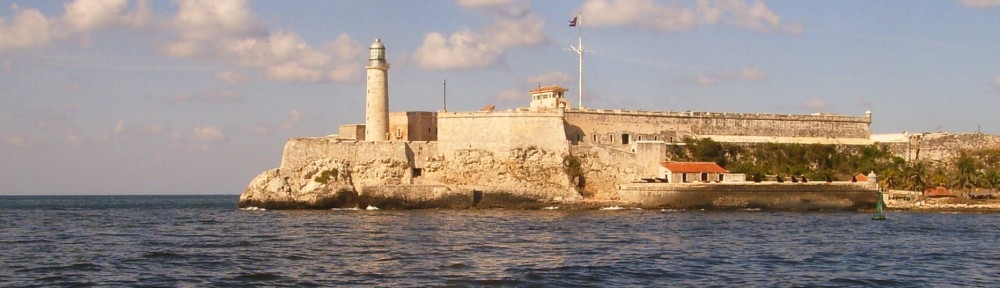
Old Cojimar Fort/Viejo Fuerte Cojimar.

Old Cojimar Fort/Viejo Fuerte Cojimar.

HEMINGWAY Y COJIMAR, CUBA, DONDE SOLO QUEDAN LO VIEJO Y EL MAR.
Por Luz Escobar, La Habana.

El embarcadero de Cojímar, donde ahora los pescadores hacen su labor con varas y cordel, la mayoría de ellos impedidos de tener una embarcación para salir al mar. (14ymedio)

El embarcadero de Cojímar, donde ahora los pescadores hacen su labor con varas y cordel, la mayoría de ellos impedidos de tener una embarcación para salir al mar. (14ymedio)

El embarcadero de Cojímar, donde ahora los pescadores hacen su labor con varas y cordel, la mayoría de ellos impedidos de tener una embarcación para salir al mar. (14ymedio)

El busto de Ernest Hemingway, salpicado de salitre, fue fundido a partir de llaves, cerraduras, viejas propelas de barcos, cadenas y tornillos de bronce. Objetos recolectados por amigos del famoso escritor y pescadores de Cojímar, un poblado que hoy vive de recordar al autor de ‘El viejo y el mar’, alejado ya de aquella épica de anzuelos y redes.

Los turistas pasan poco tiempo en esta localidad del municipio de Habana del Este, apenas unos minutos. Llegan en busca de algo que les haga revivir la hazaña del personaje de Santiago y su enorme pez, que los tiburones devoraron mientras lo traía hacia la costa. Creen que hallarán a toda la población volcada hacia las olas y los mariscos, pero encuentran una zona absorbida por la estandarización y la abulia que recorre el país.

Ninguna señal indica el sitio donde se alza la escultura del Premio Nobel de Literatura, realizada por el artista Fernando Boada sin cobrar un centavo. Solo los guías que muestran el lugar a extranjeros y los vecinos más viejos hacen un alto frente al monumento. Cuentan los lugareños que no pocos visitantes se llevan una fotografía del cercano busto de José Martí, pensando que es el escritor estadounidense.

Cojimar, Cuba.

Cojimar, Cuba.

Los turistas creen que hallarán a toda la población volcada hacia las olas y los mariscos, pero encuentran una zona absorbida por la estandarización y la abulia que recorre el país. La cita con participantes extranjeros, en el extremo opuesto de La Habana, ha robado protagonismo a la competencia local y ha derivado en un encuentro lleno de recursos y glamour. De los más de cien barcos que concursarán, solo tres son cubanos, porque, según un empleado de la exclusiva marina, se trata de una disciplina “muy cara”.

Mientras, el sitio emblemático que inspiró al escritor languidece. En años pasados, el Instituto Nacional de Deporte Educación Física y Recreación (INDER) promocionaba la justa nacional de la pesca de la aguja en Cojímar a través de la radio y la televisión. También otorgaba recursos para su realización, pero eso es historia pasada.

“Esto no es ni la sombra de lo que una vez fue”, comenta Juan, un residente del lugar que compartió momentos con Gregorio Fuentes, amigo de Hemingway y capitán de su yate ‘Pilar’.

“El pueblo estaba lleno de vida y todo se movía alrededor de la pesca”, recuerda el anciano. Cerca de donde está parado señalando hacia las olas, otros dos cojimeros beben en uno de los bancos del parque un trago de ‘canchánchara’, que crean ahí mismo mezclando un poco de aguardiente, miel y limón.

Los hombres recuerdan la poca concurrencia que tuvo la competencia de pesca del pasado fin de semana. “A eso ya no se le puede llamar ni evento”, dice el más viejo de ellos mientras bebe un sorbo. En su opinión, se ha perdido “el colorido”, porque “desde hace unos 15 años los pescadores salen y punto”.
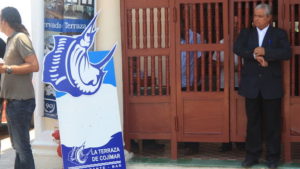
El bar Las Terrazas, donde ya no venden ningún producto del mar. (14ymedio)

El bar Las Terrazas, donde ya no venden ningún producto del mar. (14ymedio)

El otro bebedor recuerda aquella época en que los competidores “venían con uniformes de cada provincia participante” y “los barcos salían del mismo muelle donde Hemingway tenía el Pilar”. Con los años y mucho abandono, el atracadero se ha deteriorado y las embarcaciones tienen que zarpar desde otro lugar.

Durante el certamen de la aguja toda la zona se convertía en una gran fiesta, pero ahora “los kioscos con comida no tienen nada de pescado, solo pollo frito y boniato”, ironiza el hombre, que evoca los tiempos en que “se vendía calamar, mariscos y hasta manjúa”.

El temor de las autoridades radica en que los locales utilicen las frágiles embarcaciones para huir del país
Algunos han tratado de revivir la zona y enfocarla hacia el turismo. Como un cojimero que quiso montar un negocio con seis bicicletas acuáticas, pero los guardafronteras le advirtieron de que estaba prohibido gestionar algo así de manera privada. El temor de las autoridades radica en que los locales utilicen las frágiles embarcaciones para huir del país.

Cojimar, Cuba.

Cojimar, Cuba.

Ahora, varios vecinos se han unido en una idea común que intenta atraer parte de los 900.000 dólares otorgados por una fundación de Estados Unidos para construir una instalación destinada a conservar los libros, cartas y fotos del Nobel de Literatura.

“Aquí queremos hacer un monumento al patrón del Pilar”, asegura uno de los hombres sentados en el parque. “Se va a abrir el museo de Gregorio, en la casa que era de él”, detalla. “También hay que recuperar el hotel que se está echando a perder, pero tiene una vista preciosa y le daría tremenda vida a este pueblo”.

La ilusión de muchos es que el recorrido turístico que incluye la finca La Vigía “termine aquí, con un almuerzo en el bar La Terraza y una visita a la glorieta donde está el busto de Hemingway”, detalla el ilusionado lugareño. “Ojalá que Cojímar se pueda salpicar con algo”, para que ese pueblo pesquero vuelva a la vida.

Agencies/14ymedio/ Luz Escobar, La Habana/Photos/Arnoldo Varona/TheCubanHistory.com
THE CUBAN HISTORY, HOLLYWOOD.

logo

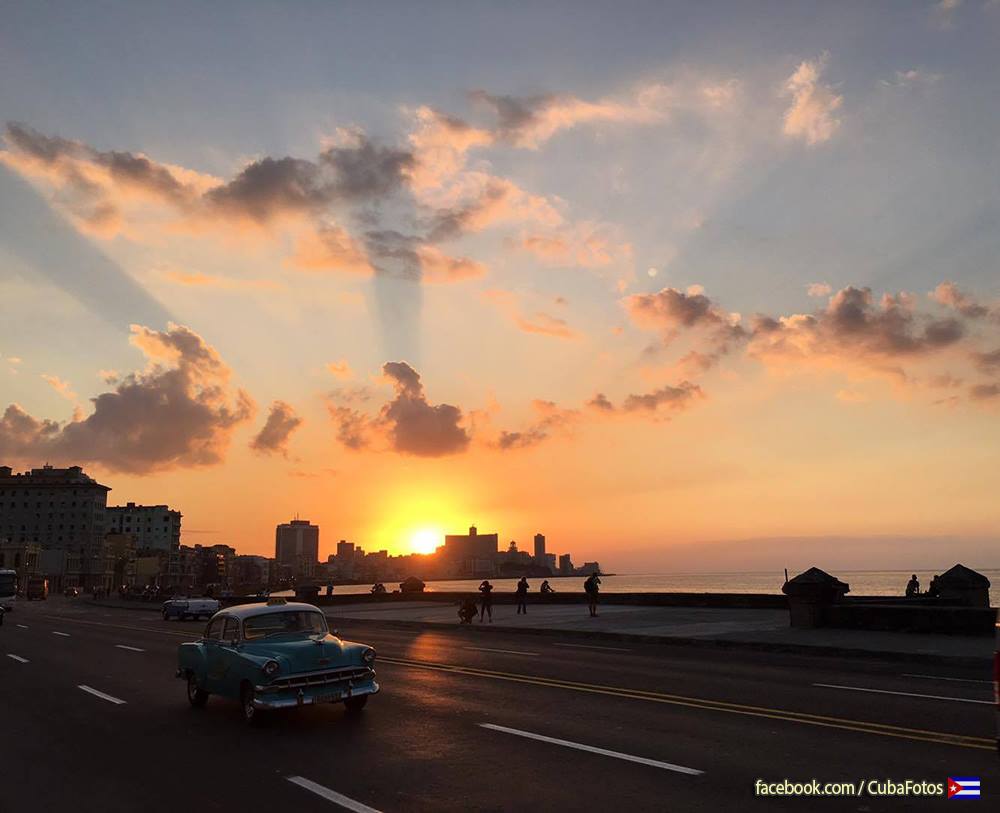
Cuba Photo: Atardecer en Playa Cubana. www.TheCubanHistory.com

Cuba Photo: Atardecer en Playa Cubana.
www.TheCubanHistory.com
— JOSÉ ARECHABALA: Origin of the ‘Havana Club’ Rum. HISTORY. + JOSÉ ARECHABALA: Origen del Ron ‘Havana Club’. HISTORIA.

Mojito-cocktail-48 JOSÉ ARECHABALA: ORIGIN OF THE ‘HAVANA CLUB’ RUM. HISTORY.

José Arechabala Aldama was born in Gordejuela, Vizcaya, on November 9, 1847. The sources consulted not allude to childhood to adolescence, but it is likely that they weren’t nothing buoyant, because with only 15 years he sought in Cuba better horizons. He arrived on the island on September 21, 1863 and worked first with his relative Antonio Galíndez Aldama, based in Matanzas, and then at the Bea home, dedicated to the provision of ships, the hardware and banking, something frequent then when the companies assumed the role of banks.

José Arechabala Aldama.

Jose Arechabala Aldama.

In 1878 entered to the game the Vizcaíno, who bought in installments to the heirs of Joaquín de Zulueta a still established in matancera city of Cardenas. He distilled the sweetness of seven or eight sugar mills in the area and received by sea raw Sagua la Grande and Yaguajay, and was valued at about 33 000 pesos gold and 167 000 pesos in bills. 1. in February 1880, the new owner enrolled him in the register under the name of La Vizcaya. From January 18, 1821, would operate under the trade name of J. Arechabala S. A. of the company founder presided over the company and work as shareholders their children Joanna, Carmela, Mercedes, José Antonio, José Nicolas. He would amass a huge capital in the field of alcohol distillation and refining of sugar and create the famous Havana Club rum.

lgarech

José Arechabala died on March 15, 1923. It became owner of the factory of gas that fed the public lighting of Cardenas and gave city a theater that carried his name. Their actions are a reflection of his devotion to the culture and good taste. The industry itself was framed in a vast array of gardens and walks, where useful and beautiful, shook hands without was a great source of employment. Cárdenas was his adopted son.

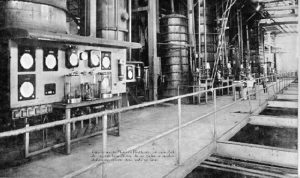
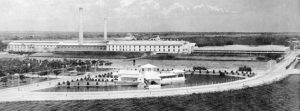
In 1958 this industrial complex occupied an area of 600 000 square meters and consisted it of plants of jams, syrup, yeast and other products derived from sugar. It had a factory of liquors, stores sugar, maritime terminal, own aqueduct, service of cabotage and shipyard. In their soleras were kept permanently two million litres aging in oak barrels.

cu_62

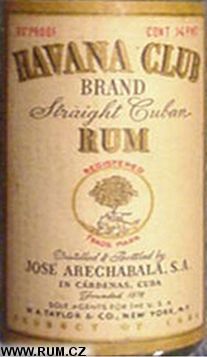
Producing anise, brandy, cream, cognac and Geneva branded Arechabala, the cognacs brands shrine and three trees, Arechabala 75 Añejo rum and other types of rums, in addition to the aforementioned Havana Club.
It represented, on the other hand, the Chivas Regal whisky and other drinks import. The sugar mills by force and progress, formed part of the company both in the province of Matanzas.

Havana Club rum is created.
On March 19, 1934 opened the liquor factory and started production of Havana Club rum. The Alco-Elite – pure, very demanded alcohol for medical purposes – was later added. Also the friendly and cognac. On May 29, 1935 opened the private Bar and the offices of the company at the Palace of the count of House Bayonne, in the square of the Cathedral of Havana. On July 18, 1936 they launched the production of jams. To develop them was adopted the most advanced technique, using selected raw materials to provide them with an exquisite flavour and expend them with an attractive presentation, which made them very popular inside and outside Cuba.

arecontr

In March 1934, the company began to produce the fuel known as mofuco. What is considered pioneer of national fuel, using alcohol as a basis. When in 1943, the world war imposed rigid controls on gasoline, the Cuban Government claimed the company contest that ground transportation is not crippled, reaching Arechabala support up to 63 percent of the national consumption.
He had J. Arechabala S. A. an active participation in getting us to admit Cuban refined sugar. It was a hard struggle which, between 1928 and 1933, freed, along with other firms, against the American authorities, to settle and clarify the right of Cuba to export that product to us and avoid the closure of Cuban refineries as well.

Their productions were over those of its competitors. In 1956 La Vizcaya produced around six million liters of spirits and spirit of 95 degrees, adding to what were the almost 800 000 litres obtained by force and progress stations. They followed him in production order distillery hell – more than six million litres – and the spirits of Cuba, with five million in brands of rum and cream Aldabo, cognac Peralta and anise of the devil. The Cuban company of Alcohol appears with more than three million liters, of Santa Cruz, and legendary names, while Bacardi, the last of the row, appears only with 3 118 000 litres.

arerefin

Of course there were disappointments and losses. The founder of the company lost and remade his fortune several times.
The hurricane of 1888, which swept the North coast of the island by the area of Cardenas and caused losses turned out disastrous for the rum. The same happened with flush of sea of 1933, causing damage to warehouses and docks, stills, tanks and barrels, buildings and boats, as well as loss of raw materials for 258 000 pesos. Harmful also were the two world wars, the fall in sugar prices and the economic crisis. And the moral troubles that shook this curious family, in which names are repeated and members end up marrying each other, which was part nothing more and nothing less than Carmelina Arechabala, which gave rise to a phrase that survives in the imagination of the Cuban, that of «live like Carmelina», to identify who leads a life gift free of gaps and concerns.

Something not clear at all to the scriptwriter happens at the end of the 1950s, when José Fermín Iturrioz leaves or they do it out of the firm that ran from 1926 and presided over since 1953, when he had to replace Carmen Arechabala – is not the Carmelina hint-, daughter of José Arechabala Aldama, the founder, and widow of José Arechabala Saiz, nephew of his father. To not vary, Iturrioz, who was the owner of the Josone removal, in Varadero, is substituted by José Arechabala Arechabala.

His departure meant for signing the loss of the station by force, which remained in the hands of Iturrioz. It had a capacity of ground of 250 000 pounds daily, 2 650 workers and 768 chivalry’s own lands.

LA CONTROVERSIA ENTRE LOS PROPIETARIOS.

LA CONTROVERSIA ENTRE LOS PROPIETARIOS.

Then…
After 1959 the factory named after José Antonio Echeverría, and in 1993, when was founded the Corporación Cuba Ron, a part of its infrastructure was destined to the creation of the Cárdenas rum. Production of this famous Winery portfolio includes Havana Club brands, ron Cubay and Sao Can brandy caneca formats. It also produces rums refining and Pearl of the North; This is their versions of white, Golden and añejo, collecting the good and genuine know-how of this ancient and famous rum.

Agencies/CiroBianchiRoss/Excerpt/InternetPhotos/Arnoldo Varona/TheCubanHistory.com
THE CUBAN HISTORY, HOLLYWOOD.


CUBA HOY/TODAY/ Raquel Pérez Díaz/Cartas de Cuba.

Mojito-cocktail-48 JOSÉ ARECHABALA, ORIGEN DEL RON ‘HAVANA CLUB’. HISTORIA.

José Arechabala Aldama nació en Gordejuela, Vizcaya, el 9 de noviembre de 1847. Las fuentes consultadas no aluden a su niñez ni a su adolescencia, pero lo seguro es que no fuesen nada boyantes, pues con solo 15 años buscó en Cuba mejores horizontes. Llegó a la Isla el 21 de septiembre de 1863 y trabajó primero con su pariente Antonio Galíndez Aldama, radicado en Matanzas, y luego en la casa Bea, dedicada a la consignación de buques, la ferretería y la banca, algo frecuente entonces cuando las empresas asumían el papel de los bancos.

José Arechabala Aldama.

José Arechabala Aldama.

En 1878 entró en el juego el vizcaíno, quien compró a plazos a los herederos de Joaquín de Zulueta un alambique establecido en la ciudad matancera de Cárdenas. Destilaba las mieles de siete u ocho ingenios azucareros de la zona y recibía por mar materia prima de Sagua la Grande y Yaguajay, y estaba valorado en unos 33 000 pesos oro y 167 000 pesos en billetes. El 1ro. de febrero de 1880, el nuevo propietario lo inscribía en el Registro Mercantil con el nombre de La Vizcaya. A partir del 18 de enero de 1821 operaría bajo la razón social de J. Arechabala S. A. Presidía la compañía el fundador de la firma y obraban como accionistas sus hijos Juana, Carmela, Mercedes, José Antonio y José Nicolás. Llegaría a amasar un capital enorme en el campo de la destilación de alcoholes y la refinación de azúcares y crearía el famoso ron Havana Club.

lgarech

José Arechabala falleció el 15 de marzo de 1923. Llegó a ser propietario de la fábrica de gas que alimentaba el alumbrado público de Cárdenas y dotó a la ciudad de un teatro que llevó su nombre. Sus actos son reflejo de su devoción por la cultura y el buen gusto. La propia industria estaba enmarcada en un vasto conjunto de jardines y paseos, donde se daban la mano lo útil y lo bello, sin contar que fue una gran fuente de empleo. Cárdenas lo declaró su Hijo Adoptivo.

En 1958 este complejo fabril ocupaba un área de 600 000 metros cuadrados y lo conformaban plantas de confituras, levadura, sirope y otras producciones derivadas del azúcar. Contaba con una fábrica de licores, almacenes de azúcar, terminal marítima, acueducto propio, servicio de cabotaje y astillero. En sus soleras se mantenían de manera permanente dos millones de litros añejándose en toneles de robles.

cu_62

Producía anís, aguardiente, cremas, coñac y ginebra con la marca Arechabala, los coñacs marcas Relicario y Tres Arbolitos, el ron añejo Arechabala 75 y otros tipos de rones, además del ya mencionado Havana Club.
Representaba, por otra parte, el whisky Chivas Regal y otras bebidas de importación. Formaban parte de la compañía los centrales azucareros Por Fuerza y Progreso, ambos en la provincia de Matanzas.

Se crea el Ron Havana Club.
El 19 de marzo de 1934 se inauguró la fábrica de licores y comenzó la producción de ron Havana Club. Más tarde se añadió el Alco-Elite —alcohol puro, muy demandado con fines sanitarios—. También los cordiales y el coñac. El 29 de mayo de 1935 abrieron el Bar Privado y las oficinas de la empresa en el palacio del Conde de Casa Bayona, en la Plaza de la Catedral de La Habana. El 18 de julio de 1936 pusieron en marcha la producción de confituras. Para elaborarlas se adoptó la técnica más avanzada, utilizándose materias primas selectas para dotarlas de un sabor exquisito y expenderlas con una presentación atractiva, lo que las hizo muy demandadas dentro y fuera de Cuba.

arecontr

En marzo de 1934, la compañía comenzó a producir el carburante conocido como mofuco. Por lo que se le considera pionera del carburante nacional, utilizando el alcohol como base. Cuando en 1943, la guerra mundial impuso rígidos controles sobre la gasolina, el Gobierno cubano reclamó el concurso de la empresa para que el transporte terrestre no se paralizara, llegando Arechabala a soportar hasta el 63 por ciento del consumo nacional.
Tuvo J. Arechabala S. A. una activa participación en lograr que EE. UU. admitiera el azúcar refinado cubano. Fue una lucha denodada que entre 1928 y 1933 libró, junto con otras firmas, contra las autoridades norteamericanas, para afincar y esclarecer el derecho de Cuba a exportar ese producto a EE. UU. y evitar así el cierre de las refinerías cubanas.

Sus producciones superaban las de sus competidores. En 1956 La Vizcaya produjo alrededor de seis millones de litros de aguardientes y alcohol de 95 grados, a lo que se sumaban los casi 800 000 litros obtenidos en los centrales Por Fuerza y Progreso. Le seguían en orden de producción la destilería Infierno —más de seis millones de litros— y la Licorera de Cuba, con cinco millones en las marcas de ron y cremas Aldabó, coñac Peralta y Anís del Diablo. La Compañía Cubana de Alcohol aparece con algo más de tres millones de litros, de las denominaciones Santa Cruz y Legendario, en tanto que Bacardí, en el último de la fila, aparece solo con 3 118 000 litros.

arerefin

Claro que hubo contrariedades y quebrantos. El fundador de la empresa perdió y rehízo su fortuna varias veces.
Resultó desastroso para la ronera el huracán de 1888, que arrasó la costa norte de la Isla por la zona de Cárdenas y ocasionó pérdidas cuantiosas. Igual ocurrió con el ras de mar de 1933, causante de daños en almacenes y muelles, alambiques, tanques y toneles, edificios y embarcaciones, así como pérdida de materias primas por 258 000 pesos. Perjudiciales fueron también las dos guerras mundiales, la caída de los precios del azúcar y las crisis económicas. Y las pesadumbres morales que sacudieron a esta curiosa familia, en la que los nombres se repiten y sus miembros terminan casándose entre sí, y de la que formó parte nada más y nada menos que Carmelina Arechabala, la que dio pie a una frase que sobrevive en el imaginario del cubano, esa de «vive como Carmelina», para identificar a quien lleva una vida regalada, libre de carencias y preocupaciones.

Algo no claro del todo para el escribidor sucede a finales de los años 50, cuando José Fermín Iturrioz sale o lo hacen salir de la firma que dirigía desde 1926 y presidía desde 1953, cuando le tocó sustituir a Carmen Arechabala —no es la Carmelina aludida—, hija de José Arechabala Aldama, el fundador, y viuda de José Arechabala Saiz, sobrino de su padre. Para no variar, Iturrioz, que era el propietario del Retiro Josone, en Varadero, es sustituido por José Arechabala Arechabala.

Su salida implicó para la firma la pérdida del central Por Fuerza, que permaneció en manos de Iturrioz. Tenía una capacidad de molida de 250 000 arrobas diarias, 2 650 trabajadores y 768 caballerías de tierras propias.

LA CONTROVERSIA ENTRE LOS PROPIETARIOS.

LA CONTROVERSIA ENTRE LOS PROPIETARIOS.

Después…
Después de 1959 la fábrica recibió el nombre de José Antonio Echeverría, y en 1993, cuando se fundó la corporación Cuba Ron, una parte de su infraestructura se destinó a la creación de la Ronera Cárdenas. La cartera de producción de esta afamada bodega contempla los formatos caneca de las marcas Havana Club, ron Cubay y el aguardiente Sao Can. Produce asimismo los rones Refino y Perla del Norte; este en sus versiones de blanco, dorado y añejo, que recoge el buen y genuino saber hacer de esta famosa y añeja ronera.

Agencies/CiroBianchiRoss/Excerpt/InternetPhotos/Arnoldo Varona/TheCubanHistory.com
THE CUBAN HISTORY, HOLLYWOOD.

logo

Cuba061

— NEW MASONIC LODGE was Constituted in Cuba. HISTORY. + NUEVA LOGIA MASÓNICA se Constituye en Cuba. HISTORIA.

NEW MASONIC LODGE WAS CONSTITUTED IN CUBA.

The Masonic lodge Los Maceo will be consecrated on coming June 14 in the city of Santiago de Cuba, in honor of the venerable family of Cuban patriots of the 19th century.

The Act of consecration is going to perform at the temple that belongs to the respectable and Meritissimo lodge L’Oasis.

250px-SantiagoDeCuba01

The date chosen for the offering of the new Masonic organisation, will coincide with the of the birth of Antonio of the Caridad Maceo Grajales, the bronze Titan, June 14 but in 1845, at the time known as Providence Street, in this town.

Two executives of the Masonic lodge Los Maceo: Adolfo Armando Bermúdez Jacas, Worshipful Master (President), and Mario Kindelán Baró, speaker, recalled that the Cuban Freemasonry began by Santiago de Cuba.

“The preceding argument is corroborated in research of Dr. Eduardo Torres-Cuevas, who found the first reference on the subject in the book history of Freemasonry”, German historian Joseph Gabriel Findel, between 1751 and 1754.

He mentions to the Grand Lodge of England, the subsequent English occupation of Havana, but he says that that Freemasonry did not establish institutions in Cuba.

Point, that after the revolution in Haiti at the end of the eighteenth century and early nineteenth, many French residents in Hispaniola, move to Cuba and with them came the first masonic lodges that operated in the largest of the Antilles. And he adds:

“These workshops were the Perseverance, La Concorde, L’ Amitié and La Concorde Benefique. The establishment of these can be specified in the year 1798. The first two were established in Santiago de Cuba, and the last two in the city of La Habana.”

download

Between 1830 and 1857 there was in Cuba no established regular or irregular masonic body.

He says that in 1862, the Cuban Freemasonry was divided to create a new institution, the Grand East of Cuba and the Antilles (GOCA); originally it had a character essentially patriotic, ethical, and social reform, where was the Cuban revolution of October 1868.

Its creator was the doctor and distinguished intellectual Vicente Antonio de Castro and Bermudez, and belonging to the GOCA; the Cuban patriots that own 10 October, start of the war of independence, the GOCA was dissolved in Havana, while in Santiago de Cuba volunteers Spanish, non-conforming, on 13, 14 and 15 February 1870 murdered to José Andrés bridge Badell, Grand Master of the lodge of Columbus; Esteban Miniet, Grand Treasurer, and other prominent personalities.

“Despite the difficult circumstances that Freemasonry was going through during the first war of Cuban independence (1868-1878), began a restoration process.”

Freedom Lodge, in the Avenida Victoriano Garzón, is enshrined in 1932 and is now set to cast sleep the Los Maceos Masonic Lodge, activity which will be attended by “Masonic brothers” throughout Cuba, led by the very respectable Grand Master of the Grand Lodge of Cuba to the and AM, located in Carlos III and Belascoain, in Havana.

gran-logia-de-la-habana_1

A summary of the arguments of the own Grand Lodge of Cuba to the AM, the network of networks, adds, moreover, that Freemasonry is not a political organization; nor is it a religious sect; Masons meet and work regularly; that is undeniable social influence that has had this fraternal Association in modern history; in Cuba masonry also has an illustrious past, inextricably linked to the same formation of nationality and that their ranks fought men who then fought for the independence of the country…

“Article 1, subparagraph I of the Cuban Masonic Constitution declares that”Freemasonry is the organic institution of morality”, morality, understood as respect for himself and the society in which sits, and this criterion represents aspiration to a lifestyle whereby masons, not only within the fraternity should be distinguished , but also in any location.

Agencies / Miguel A. Gainza Chacón/InternetPhotos/Arnoldo Varona/TheCubanHistory.com
THE CUBAN HISTORY, HOLLYWOOD.

CUBA PHOTOS.

CUBA PHOTOS.

NUEVA LOGIA MASÓNICA SE CONSTITUYE EN CUBA.

La Logia Masónica Los Maceo será consagrada el venidero 14 de junio en Santiago de Cuba, en honor a la venerable familia de patriotas cubanos del siglo XIX.

El acto de consagración se va a efectuar en el Templo que pertenece a la Respetable y Meritisima Logia L’Oasis.

La fecha escogida para la ofrenda de la nueva organización masónica, coincidirá con la del natalicio de Antonio de la Caridad Maceo Grajales, el Titán de Bronce, el 14 de junio pero de 1845, en la entonces conocida como calle Providencia, en esta ciudad.

download

Dos directivos de la Logia Masónica Los Maceo: Adolfo Armando Bermúdez Jacas, Venerable Maestro (presidente), y Mario Kindelán Baró, orador, recordaron que la masonería cubana comenzó por Santiago de Cuba.

El argumento precedente es corroborado en investigaciones del Dr. Eduardo Torres-Cuevas, quien encuentra la primera referencia sobre el tema en el libro Historia de la Francmasonería”, del historiador alemán Joseph Gabriel Findel, entre 1751 y 1754.

Menciona a la Gran Logia de Inglaterra, la posterior ocupación inglesa de La Habana, pero asegura que esa masonería no llegó a fundar instituciones en Cuba.

Apunta, que luego de la Revolución en Haití a finales del siglo XVIII y principios del XIX, numerosos franceses residentes en La Española, se trasladan a Cuba y con ellos llegaron las primeras logias masónicas que funcionaron en la mayor de la Antillas. Y agrega:

“Estos talleres fueron La Persévérance, La Concorde, L’Amitié y La Bénefique Concorde. El establecimiento de estos puede precisarse en el año 1798. Las dos primeras se establecieron en Santiago de Cuba y las dos últimas en la ciudad de La Habana.”

Entre 1830 y 1857 no hubo en Cuba ningún cuerpo masónico regular o irregular establecido.

Dice que en 1862, la masonería cubana quedó dividida al crearse una nueva institución, el Gran Oriente de Cuba y las Antillas (GOCA); que en su origen tuvo un carácter esencialmente patriótico, ético y de reforma social, donde se gestó la Revolución Cubana de octubre de 1868.

250px-SantiagoDeCuba01

Su creador fue el médico y distinguido intelectual Vicente Antonio de Castro y Bermúdez, y que los patriotas cubanos pertenecían al GOCA; que el propio 10 de octubre, inicio de la Guerra de Independencia, el GOCA fue disuelto en La Habana, mientras en Santiago de Cuba los voluntarios españoles, no conformes, los días 13, 14 y 15 de febrero de 1870 asesinaron a José Andrés Puente Badell, Gran Maestro de la Logia de Colón; Esteban Miniet, Gran Tesorero, y a otras prominentes personalidades.

“A pesar de las difíciles circunstancias por las que atravesaba la masonería durante la primera guerra de independencia cubana (1868-1878), se inició un proceso de restauración.”

En 1932 se consagra la Logia Libertad, en la Avenida Victoriano Garzón, y ahora, se establecerá en el reparto Sueño la Logia Masónica Los Maceos, actividad a la que asistirán “hermanos masónicos” de toda Cuba, encabezados por el Muy Respetable Gran Maestro de la Gran Logia de Cuba AL y AM, ubicada en Carlos III y Belascoaín, en La Habana.

gran-logia-de-la-habana_1

Un extracto de los argumentos de la propia Gran Logia de Cuba AL y AM, en la red de redes, añade, además, que la masonería no es una organización política; tampoco es una secta religiosa; que los masones se reúnen y trabajan regularmente; que es innegable la influencia social que ha tenido esta asociación fraternal en la historia moderna; que en Cuba la masonería también cuenta con un pasado ilustre, indisolublemente ligado a la formación misma de la nacionalidad y que en sus filas militaron los hombres que luego lucharon por la independencia del país…

“El artículo primero, inciso I de la Constitución Masónica Cubana declara que “La masonería es la institución orgánica de la moralidad”, la moral entendida como el respeto a sí mismo y a la sociedad en la que se asienta, y este criterio representa la aspiración a un estilo de vida por el que deben distinguirse los masones, no sólo dentro de la fraternidad, sino también en cualquier medio donde se encuentre.

Agencies/Miguel A. Gaínza Chacón/InternetPhotos/Arnoldo Varona/TheCubanHistory.com
THE CUBAN HISTORY, HOLLYWOOD.

logo

WWW.THECUBANHISTORY.COM

WWW.THECUBANHISTORY.COM