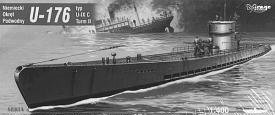
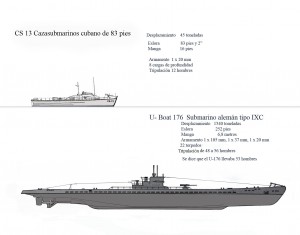
During the Second World War the primary military activity of Cuba was concentrated on her navy, which executed a great number of missions in support, escort and rescue. Of these the most noteworthy one was probably the sinking of the German submarine U176 by the Cuban submarine hunter CS13 under command of Ensign Ramirez.
SC-13, was one of the submarine chasers acquired by the Cuban government in the United Stated during the Second World War under the Lend Lease treaty, it was the naval vessel responsible for the sinking of the German submarine U176.

In the port of Sagua Grande a slight breeze was going, it was the afternoon of the 15th of May 1943, the merchant vessels Wanks und Camagüey wearing the flags of Honduras and Cuba respectively, had unmoored their ropes to head for the port of Matanzas forming a convoy. More than thrice the time of departure had been changed without any evident reason except for the only one giving a possible explanation: to create confusion if said information made its way filtering through to the enemy.
Finally not withstanding, order was given to weigh anchors, because among other prohibitions a ban had been established not to sail into the dusk of evening, if not absolutely necessary, owing to the imminent dangers the presence of submarines caused, which used to exploit the darkness of the night to execute their attacks. Aboard the Cuban merchantman reined a sentiment of sadness and desolation, only a few hours had passed since the insidious attack of a German submarine against the Cuban tanker Mambi had claimed an high toll of victims. Dismay had seized the Cuban crew, some of the sailors had brought with them from landside the last editions of the national press and the local journal „ El Comercio“(The Commerce), which spread the ill boding news of the sinking of the Mambi in enormous headlines; the Cuban sailors had decided, without waiting for instructions by the company operating their ship, to fly the national ensign at half staff as a sign of mourning for their comrades, who had fallen fulfilling their duties. The actual possibility to also fall victim to a similar attack had increased the apprehension among all every time but at the same time a feeling of solidarity provided them with the strength to face whatever sacrifice.

Lining up at the mouth of the bay, three submarine hunting boats had joined the ones forming the convoy to sail to their next destination. Some sailors remained on deck or close to the bridge, silent and their eyes fixed onto the vastness of the sea, some remembered the anecdotes of the survivors, who had grimly suffered that infernal and inexpressible experience of corpses floating amidst wood in an ocean thick and sticky, a mixture of saltwater, oil, fuel and blood, which causes nausea or even suffocating asphyxia, like the evaporations of ammonia from the Nikeliner, also torpedoed, which began to penetrate the air enclosing that apocalyptic scene.
The freighters Wanks and Camagüey continued to proceed at a speed of eight knots, the regulation for convoys and flanking submarine hunters; one of them, CS12 manoeuvered constantly changing from one side of the merchantmen to the other in free operation of providing cover; at the head of the convoy CS11, chief of the escort sailed and closing the protection at the rear found CS13.
At 17:15 hours, position 23 degrees 21 minutes Northern latitude and 080 degrees 18minutes Western longitude an hydroplane of the North American navy appeared in the deep blue sky, a Vrought-Sikorsky Kingfisher, belonging to VS62 squadron based at Cayo Frances, a naval station formed by a moored vessel named San Pascual, armed with six heavy machine guns and two artillery pieces. The San Pascual held a communication squadron, was firmly moored onto land and served as a fuel supply station supporting six hydroplanes and eight submarine hunters. Arriving on the spot, the Kingfisher dropped a smoke bomb and started to fly circles around the zone marked by the dropping of the bomb, about one and a half mile starboard astern of the boat leading the escort. The commander of CS11 ordered state of alert for his forces due to the imminent presence of a submarine; ordered by radio CS13 headed for the zone signalled by the airplane. CS13 was commanded by Ensign Mario Ramirez Delgado, whom the Cuban naval command had placed at the helm of one of the twelve submarine hunters acquired by the government of Cuba in the Unites States under the Lend Lease programme, which resulted from a military and naval agreement signed between the two nations a year ago on September 7th, 1942 with the declared objective to reinforce the defensive capacities of the Cuban fleet and to strengthen her role in the Caribbean.
The convoy had veered 45 degrees to port while CS13 now at full power at a speed of 15 knots headed towards the zone of confrontation; at about 400 yards from the target sonar operator Norberto Collado established contact with the submerged enemy, whose echo returns sounded very clear with marked Doppler effect and propeller noise: the target now rushed headlong and initiated a rapid dive knowing to be discovered and threatened; it was then that the commander of CS13 Ensign Ramirez ordered to veer 25 degrees onto the target and to attack by throwing an immediate first depth charge fixed on 100feet, followed by two more with 150 and 200feet respectively, changing course between the second and third charge to correct for any additional speed the submarine may make in her attempt to escape. The first two charges detonated normally, throwing up two enormous columns of water foamy and white, while after the third detonation a fourth one was heard, maybe provoked by the explosion of the submarine’s torpedo room; on this occasion the detonation had so much force, it caused the stern of the submarine hunter to immerge, with water even beginning to penetrate into the engine room; this last detonation was accompanied by a column of water of muddy turbid colour which rose to an height much above the previous ones. The submarine hunter veered to port and stopped her engines; on the sonar system the contact with the target was re-established at about 500 yards, but on this occasion did not show any movement, neither engine noise nor Doppler effect; the contact now was very clear and metallic and sailor Norberto Collado confirmed to the captain of the ship that what was heard could not be caused by the water eddies and vortices produced by the depth bomb, therefore Ensign Ramirez thought that the submarine remained silent and proceeded ordering to keep the engines throttled, maintaining the vessel that way for a period of three minutes, after which he ordered to start them again and attack anew; this time the depth of the submarine was found to be 400 yards and in the wake of a new attack two more charges were launched, one at 200 the other at 400 yards. Shortly after the second attack, CS13 was placed over the area of the last detonation and her engines again silenced. A careful acoustic sounding was initiated; it produced no contact but during about two minutes something was heard, which seemed like sounds produced by air bubbles in the water escaping from an half closed container, which in judgement of captain and sonar operator could in no case be provoked by the launching of the last depth charge, as this had taken place eight minutes ago.

The third charge launched in the first attack had produced the appearance of a small stain of fuel on the surface of the sea, which grew steadily until it reached a diameter of approximately 300 yards. Then the captain of the submarine hunters ordered one of the sailors of his crew to collect samples of that stain with the help of a pail to have them later analysed in the marine laboratories. Unfortunately said sample was later lost due to rough sea off Matanzas and the little of it which could be saved in the container in addition to its contamination, proved to be insufficient to realize a precise chemical analysis..
After the attack CS13 remained in the area of the encounter for a period of two hours at the end of which she ran full speed to again join the convoy, which she reached around 19:35 hours.
During the course of return the Kingfisher plane overflew the convoy at low altitude and the radio operator in the rear cockpit moved his hands clasped at his head’s level as a sign of congratulation for CS13. The submarine sunk was U176 the same one, which some hours ago had brought death to the merchantmen Mambi and Nikeliner, only on this occasion she could not complete the mission she had prepared for, being destroyed before she was able to escape.
 Mario Ramírez Delgado was born in the town of San Fernando de Camarones belonging to the former province of Las Villas province of Cienfuegos now. Studied 5 years at the Naval Academy in Mariel. He was chosen to study in the United States Navy delivered the new technique to Cuba on March 22, 1943.
Grade of ensign on May 15, 1943 commanding the CS 13 sank the German submarine U-176 in its first act of war, at 23 ° 21 ‘0 North and 80 ° 18’ 0 West, the north of Key Megano, then Las Villas province. He had a record of 15,000 miles protecting convoys travel during World War II. Awarded Medal of Naval Merit with distinctive red and the Medal of the Congress of the United States.
 Reiner Dierksen was the commander of U-176, held the rank of lieutenant commander and was awarded “The Iron Cross” by the actions taken with your submarine. He had in his record sinking 10 ships and damaged one. Born on 24 Mar 1908 in Esenshausen, Baden-Württemberg. Crew 33. Korvettenkapitän (1 May 1943). Died on 15 May 1943, Cuban waters.
Source:LaMuerteSurcaelCaribe/MaximinoGomezAlvarez/InternetPhotos/Uboat.net/Wildy/TheCubanHistory.com
Cuba: The Sinking of the German U-176
The Cuban History/ Arnoldo Varona, Editor
Note: This work was written by the historian Maximino Gomez Alvarez of Cuban descent; this researcher is the author of the documental script: “El incidente 3208: hundimiento del U176“ (Incident 3208: the Sinking of U176), according with the date, a production has been terminated by the studios of Impacto Film Producciones S.A. He also has a work entitled: “La Muerte Surca el Caribe“ (Death roams the Caribbean).


CUBA: EL HUNDIMIENTO DEL SUBAMARINO ALEMAN U-176
Durante la Segunda Guerra Mundial la principal actividad militar de Cuba, estuvo centrada en su Marina de Guerra, la que cumplió gran cantidad de misiones de apoyo, escolta y salvamento. Quizás el hecho más notable los constituyó el hundimiento del Submarino Alemán U-176 por el Cazasubmarino cubano CS-13, comandado por el Alferez Ramirez.
El Sc-13 uno de los Caza Submarinos (Subchaser) adquiridos por el Gobierno Cubano en Estados Unidos,durante la Segunda Guerra Mundial, a través del Programa Lend Lease, fue el responsable del hundimientos del Submarino Alemán U-176.
Historia naval
En el Puerto de Sagua la Grande corría una tenue brisa, era la tarde del 15 de mayo de 1943, los mercantes Wanks y Camagüey de banderas hondureña y cubana respectivamente habían soltado amarras para dirigirse, formando convoy, rumbo al puerto de Matanzas; en más de tres ocasiones se había fijado la hora de partida sin que existiera una causa aparente, lo que sólo podía ser explicado con la intención de crear confusión, si dicha información lograba filtrarse al enemigo; no obstante, finalmente se dio la orden de zarpar, debido a que entre otras prohibiciones, se había establecido la de no navegar al anochecer, si ello no era absolutamente necesario, por los peligros que entrañaban la presencia de los submarinos que aprovechaban la oscuridad de la noche para efectuar sus ataques. A bordo del mercante cubano reinaba un sentimiento de tristeza y desolación, sólo habían transcurrido unas horas, desde que se había producido el artero ataque de un sumergible alemán contra el buque cisterna cubano Mambí, con un saldo elevado de víctimas.
El desconcierto se había apoderado de la tripulación cubana; algunos marineros habían traído consigo desde tierra los últimos ejemplares de la prensa nacional y del periódico local “El Comercio”, que con enormes titulares desplegaban la nefasta noticia del hundimiento del Mambí; los marineros cubanos habían decidido, aún sin contar con instrucciones al respecto por parte de la compañía naviera que operaba su embarcación, ordenar izar a media asta la enseña nacional, en señal de luto por los camaradas caídos en el cumplimiento de su deber. La posibilidad real de ser víctimas de un ataque similar hacía aumentar cada vez más el temor entre todos, pero al mismo tiempo, un sentimiento de solidaridad les daba fuerza para enfrentar cualquier sacrificio.
Al enfilar la boca de la bahía, se habían sumado tres buques caza submarinos con los que se formarían convoy, para dirigirse a su próximo destino; algunos marineros permanecían en cubierta o muy cerca del puente de mando en silencio y con sus ojos fijos en la inmensidad del mar, algunos recordaban las anécdotas de los sobrevivientes, quienes había sufrido aquella experiencia infernal e inenarrable de cadáveres flotando entre maderos, en un mar denso y pegajoso, mezcla de agua salada, aceite, combustible y sangre que lo hacía nauseabundo e incluso asfixiante, cuando las emanaciones de armoniaco procedentes del Nickeliner, igualmente torpedeado, comenzaron a impregnar la atmósfera que envolvía aquel apocalíptico paisaje.
Los cargueros Wanks y Camagüey continuaban avanzando a la velocidad de 8 nudos, la reglamentaria para los convoyes y flanqueados por los cazasubmarinos; uno de ellos, el CS-12, se movía constantemente, situándose a un lado u otro de los mercantes en franca maniobra de cobertura; al frente del convoy viajaba el CS-11, Jefe de la Escolta y cerrando la protección, se encontraba el CS-13. A las 17:15 horas en la latitud 23º,21´y longitud 80º,18´oeste, con el cielo teñido de un azul intenso apareció un hidroavión de la Marina norteamericana, un Vougt Sikorsky Kingfisher, perteneciente al Escuadrón VS-62 con base en Cayo Francés, una estación naval formada por un buque de ferrocemento llamado San Pascual, armado con 6 ametralladoras pesadas y 2 cañones, donde radicaba una escuadra de comunicaciones, el cual estaba fijado a tierra por anclajes y que servía para el reabastecimiento de combustible y en el tenían su base 6 hidroaviones 8 cazasubmarinos.
Al acercarse al lugar, el Kingfisher lanzó una bomba de humo y comenzó a volar describiendo círculos en torno a la zona de lanzamiento marcada por el artefacto, distante como a una milla y media a estribor de la popa del barco que lideraba la escolta; el Comandante del CS-11 puso en estado de alerta sus fuerzas ante la inminente presencia de un submarino, ordenando por radio al CS-13, que se dirigiera a la zona señalada por el avión. El CS-13 estaba capitaneado por el Alférez de Fragata Mario Ramírez Delgado, a quien el mando naval cubano había colocado al frente de uno de los 12 caza submarinos adquiridos por el Gobierno de Cuba en los Estados Unidos a través de un Programa Lend-Leasse, resultante del Acuerdo Militar y Naval suscrito entre ambas naciones un año antes, el 7 de Septiembre de 1942 con el franco objetivo de reforzar la capacidad defensiva de la Armada Cubana y su papel en Caribe.
Triunfo Naval cubano
El convoy había girado 45º a babor y para entonces el CS-13 ya se dirigía a toda máquina, a la velocidad de 15 nudos, en dirección a la zona de confrontación; al aproximarse a unas 400 yardas del objetivo, el Operador de Sonar, Norberto Collado estableció contacto con el sumergible enemigo, cuyo sonido resultó ser muy claro con marcado efecto doopler y ruido de propela; el objetivo se movía entonces apresuradamente e iniciaba una rápida inmersión al saberse descubierto y amenazado; fue entonces que el Comandante del CS-13, el Alférez Ramírez ordenó girar 25º sobre el objetivo y atacar, produciéndose de inmediato el lanzamiento de la primera carga de profundidad, prefijada ésta a 100 pies, seguida de otras dos, a 150 y 200 pies respectivamente, cambiando el rumbo entre la segunda y tercera carga, para corregir cualquier velocidad adicional aplicada por el submarino en su intento de evadirse. Las dos primeras cargas explosionaron normalmente, provocando el levantamiento de dos enormes columnas de agua espumosa y clara, en cambio, tras la tercera explosión se escuchó una cuarta, quizás provocada por el estallido de la sala de torpedos del submarino y en esta ocasión, la explosión fue de tal virulencia que el caza submarino hundió su proa en el agua, la que llegó a penetrar hasta el cuarto de máquinas; ésta última explosión estuvo acompañada por una columna de agua de color pardo fangoso que se elevó a una altura muy superior a las anteriores, entonces el caza submarino giró a babor y apagó sus motores; por el aparato de sonar se recobró el contacto con el objetivo a unas 500 yardas, pero en esta ocasión no se produjo movimiento, ni ruido de motores, ni efecto doppler; el contacto ahora era muy claro y metálico y el marinero Norberto Collado manifestó al Capitán de la nave que lo que escuchaba no podía provenir del remolino provocado por la bomba de profundidad, por lo que el Alférez Ramírez pensó que el submarino permanecía quieto, y procedió a ordenar que se apagaran los motores, manteniendo así la nave por espacio de tres minutos al cabo de lo cual ordenó ponerlos en marcha nuevamente y atacar; esta vez la profundidad del U-boat fue fijada a 400 pies, procediéndose a un nuevo ataque, lanzándose otras dos cargas, una a 200 y la otra a 400 pies.
Poco después del segundo ataque, el CS-13 se colocó sobre el área de la última explosión y silenciando nuevamente sus motores, inició un cuidadoso sondeo acústico; no se produjo entonces ningún contacto, pero fueron escuchados durante aproximadamente dos minuto algo parecido al sonido que provocan las burbujas de aire en el agua, al escapar de un recipiente semicerrado, lo que a juicio del Capitán y el operador de sonar, no podían en ningún caso, estar provocados por el lanzamiento de la última carga de profundidad, debido a que la misma había tenido lugar 8 minutos antes. La tercera carga lanzada en el primer ataque, produjo la aparición de una pequeña mancha de combustibles en la superficie del mar que fue aumentando de tamaño hasta llegar a alcanzar un diámetro de cerca de 300 yardas, entonces el Capitán del Cazasubmarinos ordenó a uno de los marineros de su tripulación que recogiera con la ayuda de un cubo, muestras de aquella mancha para que fuera posteriormente analizada en el Laboratorio de la Marina; desafortunadamente, dicha muestra se perdió posteriormente a causa de la mar picada que luego se presentó a la altura de Matanzas y lo poco que pudo salvarse de la misma en el recipiente, además de adulterado, resultaba insuficiente para la realización de un análisis químico preciso. Después del ataque, el CS-13 permaneció en el área del encuentro por espacio de dos horas al cabo de lo cual se dirigió a toda velocidad para incorporarse nuevamente al convoy, lo que se produjo alrededor de la 19:35 horas.
Durante el trayecto de retirada, el avión Kingfisher sobrevoló el convoy a baja altura y el operador de radio de la aeronave, situado en la carlinga trasera agitó sus manos entrelazadas a la altura de la cabeza en señal de felicitación al CS-13. El U-boat hundido era U-176, el mismo que unas horas antes sembrara la muerte en los mercantes Mambí y el Nikeliner, sólo que en esta ocasión no pudo cumplir la misión para la que se había preparado, siendo destruido antes de que pudiera escapar…
* Mario Ramírez Delgado nació en el pueblo de San Fernando de Camarones perteneciente a la antigua provincia de Las Villas, actual provincia Cienfuegos (mi ciudad natal). Estudió 5 años en la Academia Naval del Mariel. Fue escogido para estudiar en los Estados Unidos la nueva técnica naval entregada a Cuba el 22 de marzo de 1943. Con grado de alférez de fragata el 15 de mayo de 1943 comandando el CS 13 hundió el submarino alemán U- 176 en su primera acción de guerra, en los 23° 21´ .0 Norte y los 80° 18´ .0 Oeste, al norte de Cayo Megano, entonces provincia Las Villas. Tuvo un record de 15000 millas de recorrido protegiendo convoyes durante la II Guerra Mundial.Condecorado con Medalla del Mérito Naval con distintivo rojo y la Medalla del Congreso de los Estados Unidos.
Reiner Dierksen era el comandante del U- 176, ostentaba el grado de capitán de corbeta y había sido condecorado con “La Cruz de Hierro” por las acciones realizadas con su submarino. Tenía en su record el hundimiento de 10 barcos y uno dañado. Nacido el 24 de marzo 1908 en Esenshausen, Baden-Württemberg. Tripulación 33. Capitán de corbeta (1 de mayo de 1943). Murió el 15 de mayo de 1943, en aguas cubanas.
Aquí los nombres de la tripulación del CS 13 según aparece en publicación de la época después de terminada la Segunda Guerra Mundial:
Alférez de fragata Mario Ramírez Delgado – Comandante; Alférez de fragata Carlos Cuadra Garrote – Segundo comandante; Cabos de mar – Luís G. Valdés Martínez
Cabo fogonero Cesáreo Barcelar Cobillón; Marineros – Santiago Rodríguez Ávila, José Rubira Quintana, Juan Pérez Hernández, Eligio Carcases Gutiérrez, Roberto J. Bayona Gutiérrez, Luís M. A. Veranes Catasus, Andrés Abela de Aróstegui, Norberto A. Collado Abreu.
Source:LaMuerteSurcaelCaribe/MaximinoGomezAlvarez/InternetPhotos/Uboat.net/Wildy/TheCubanHistory.com
La Muerte Surca el Caribe
The Cuban History/ Arnoldo Varona, Editor
Sources/Nota:
El trabajo que aqui se detalla fue escrita por el historiador de origen cubano Maximino Gómez Alvarez; éste investigador es el autor del Guión del Documental “El Incidente 3208: hundimiento del U-176”, en los estudios de Impacto Film Producciones S.A. según se reseña por su fecha en 1977, se ha terminado tambien una obra titulada “La Muerte Surca el Caribe”.