


 CUBA TODAY: Hundreds of detainees in the protests in Cuba are being tried in summary proceedings. PHOTOS. * CUBA HOY: Cientos de Detenidos en las Protestas en Cuba estan siendo Juzgados en Procesos Sumarios. PHOTOS.
CUBA HOY: CIENTOS DE DETENIDOS EN LAS PROTESTAS EN CUBA ESTAN SIENDO JUZGADOS EN PROCESOS SUMARIOS. PHOTOS.
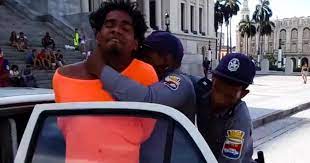
Cuban Prisoners Defenders denuncia la vulneración de los derechos de los arrestados. Un manifestante es detenido por un policía y un agente de la Seguridad del Estado vestido de civil, este 11 de julio en La Habana. La ONU denuncia 187 víctimas de desaparición forzada en Cuba. El régimen cubano resucita las guardias obreras para proteger los centros de trabajo. Biden estudia reautorizar las remesas y enviar más diplomáticos a la Isla.
Un manifestante es detenido por un policía y un agente de la Seguridad del Estado vestido de civil, este 11 de julio en La Habana. (14ymedio)
OCHO DIAS después del inicio de las protestas en más de 40 ciudades cubanas aún no hay cifra oficial de arrestados en las manifestaciones. Varias organizaciones de derechos humanos hablan de “miles” mientras la ONU señala 187 víctimas de desaparición forzada.
Entre ellos figuran activistas conocidos, como José Daniel Ferrer o el artista Luis Manuel Otero Alcántara, pero los detenidos son, en su mayoría, cubanos desconocidos que salieron a la calle para expresar su deseo de libertad y su hartazgo ante un régimen de 62 años que ha destruido el país.
Todos, sin embargo, tienen algo en común según un informe jurídico publicado por Cuban Prisoners Defenders (CPD): están sometidos a la vía del proceso sumario conocido como el “atestado directo”.
“Se denomina así porque se pasa de la investigación policial, sin acusación fiscal ni proceso, a la vista oral”, explica la organización con sede en Madrid. “Es la policía, el instructor policial –no existe juez instructor en Cuba, figura que fue abolida por Fidel Castro–, y no la fiscalía, quien maneja las riendas del proceso de principio a fin”.
Se trata de “un proceso policial, no judicial”, califica CPD, en el que la Policía “inicia, interviene y controla todo el proceso, incluso el señalamiento de la fecha del juicio”.
“Atribuir únicamente a la situación económica como motivo de las protestas, como ha hecho la señora Bachelet, es no entender absolutamente nada de lo que sucede en Cuba”
Una vez que los agentes indican al juez que el proceso será por “atestado directo”, ellos mismos establecen la vista oral con el juez, “sin que el fiscal, ni abogado, ni acusado estén presentes o conozcan la causa en dicha reunión”, detalla la ONG.
El acusado no tiene acceso en ningún momento al expediente, que consiste en un “informe resumido acusatorio” y no es redactado por un fiscal sino por el agente policial. “El fiscal puede optar por no participar, y el juicio seguirá adelante sin él”, explica el documento. “Si hay abogado, sólo éste ve someramente el expediente escasos minutos antes de la vista”.
“Desde el inicio del atestado directo hasta que se dicta sentencia, como mucho, no transcurren más de cinco días”, asevera CPD: “De uno a cuatro días para denunciar e investigar y 24 horas para formar causa en el tribunal, hacer juicio oral y dictar sentencia oral. Pero pueden ser, como en este caso, entre 48 y 96 horas”.
El objetivo, según las autoridades, es establecer “un método y una vía, ágiles y expeditas, de dar curso legal a los asuntos que se tramitan dentro del procedimiento sumario en los tribunales municipales”. Sin embargo, CPD asegura que con su aplicación “se viola flagrantemente la garantía del debido proceso establecido en los artículos 94 y 95 de la Constitución”, además de la legislación internacional y el derecho a la defensa efectiva.
También se vulnera, dice la organización, los derechos a nombrar defensor y a comunicarse con allegados para la recolección de pruebas, “pues no está garantizada la presentación de éstas por parte del acusado”, además del principio de publicidad al que está obligado todo proceso debido. El “atestado directo” implica, refiere CPD, “un proceso relámpago, sin comunicación a los interesados y a puertas cerradas”, análogo “al proceso accusatio de la Antigua Roma”.
En un comunicado publicado este sábado, el OCDH lamentó que Josep Borrell, jefe de la diplomacia europea, y Michelle Bachelet, alta comisionada de la ONU para los Derechos Humanos, “intenten desviar la atención sobre los motivos de las masivas protestas de los últimos días en Cuba”.
“Ha habido muchas peticiones en las manifestaciones, pero las frases que más se escucharon fueron ‘libertad’ y ‘no tenemos miedo’. Atribuir únicamente a la situación económica como motivo de las protestas, como ha hecho la señora Bachelet, es no entender absolutamente nada de lo que sucede en Cuba”, sentencia en un comunicado Alejandro González Raga, director ejecutivo de la organización, también con sede en Madrid.
José Daniel Ferrer Cantillo denunció que golpearon a todas las personas que entraron en la estación de Policía adonde lo llevaron, “jóvenes, ancianos, todos los que lograron detener ese día”.
Del mismo modo, González Raga dice que Borrell “se equivoca al responsabilizar a Estados Unidos” y asevera: “Estas protestas resumen 62 años de represión. Es Cuba la que tiene que cambiar. Hay que poner el foco completamente en los responsables de que hoy Cuba sea una dictadura. Los factores externos influyen, pero el problema es la dictadura”.
José Daniel Ferrer Cantillo, hijo del dirigente de la Unpacu, detenido junto a su padre el mismo domingo 11, antes de que pudieran participar en la manifestación que estaba teniendo lugar en en Santiago de Cuba, y liberado este domingo, narró en un video que lo acusaron de un delito de “incitación al desorden público”, de “propagación de epidemias” y de “desorden público”, luego “rebajados”, según le informaron, “a desorden público nada más”, por lo que le levantaron “un acta de advertencia” y le dijeron que debía comprometerse a no participar en ninguna marcha e ir a firmar todos los martes a la estación policial de Versailles.
Al negarse, lo amenazaron con imponerle prisión provisional, medida a la que está sometido su padre. El joven denunció, además, que golpearon a todas las personas que entraron en la estación de Policía adonde lo llevaron, “jóvenes, ancianos, todos los que lograron detener ese día” y que entre los presos se encuentra una embarazada a la que no dan la atención que necesita.
Asimismo, su padre, informa, se encontraba en una crisis de úlcera cuando salió de su casa, y que se encuentra mal. “Ahí está en las peores condiciones del mundo, eso es como un campo de concentración”.

RECOMIENDENOS A SUS AMISTADES * PREFIERA A NUESTROS SPONSORS.

CUBA TODAY: HUNDREDS OF DETAINEES IN THE PROTESTS IN CUBA ARE BEING JUDGED IN SUMMARY PROCESSES. PHOTOS.
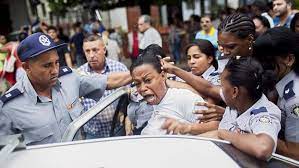
Cuban Prisoners Defenders denounces the violation of the rights of those arrested. A protester is detained by a policeman and a State Security agent in civilian clothes this July 11 in Havana. The UN denounces 187 victims of forced disappearance in Cuba. The Cuban regime resurrects the workers’ guards to protect the work centers. Biden is studying reauthorizing remittances and sending more diplomats to the island.
A protester He is detained by a policeman and a State Security agent in civilian clothes this July 11 in Havana. (14ymedio)
EIGHT DAYS after the start of the protests in more than 40 Cuban cities, there is still no official number of people arrested in the demonstrations. Several human rights organizations speak of “thousands” while the UN indicates 187 victims of enforced disappearance.
Among them are well-known activists, such as José Daniel Ferrer or the artist Luis Manuel Otero Alcántara, but the detainees are, for the most part, unknown Cubans who took to the streets to express their desire for freedom and their exhaustion in the face of a 62-year-old regime that it has destroyed the country.
All, however, have something in common according to a legal report published by Cuban Prisoners Defenders (CPD): they are subject to the summary process known as the “direct attestation.”
“It is so-called because it goes from the police investigation, without prosecution or process, to the oral hearing,” explains the Madrid-based organization. “It is the police, the police instructor – there is no investigating judge in Cuba, a figure that was abolished by Fidel Castro – and not the prosecution, who handles the reins of the process from beginning to end.”
It is “a police process, not a judicial one,” says CPD, in which the police “initiate, intervene and control the entire process, including the setting of the date of the trial.”
“To attribute solely to the economic situation as the reason for the protests, as Mrs. Bachelet has done, is to not understand absolutely anything of what is happening in Cuba”
Once the agents indicate to the judge that the process will be by “direct evidence”, they themselves establish the oral hearing with the judge, “without the prosecutor, the lawyer, or the accused being present or knowing the cause in said meeting”, details the NGO.
The accused does not have access at any time to the file, which consists of an “accusatory summary report” and is not drawn up by a prosecutor but by the police officer. “The prosecutor can choose not to participate, and the trial will go ahead without him,” the document explains. “If there is a lawyer, only he briefly sees the file a few minutes before the hearing.”
“From the beginning of the direct report until the sentence is handed down, at most, no more than five days elapse,” says CPD: “From one to four days to report and investigate and 24 hours to form a case in court, make an oral trial and issue an oral sentence. But it can be, as in this case, between 48 and 96 hours. ”
The objective, according to the authorities, is to establish “a method and a path, agile and expeditious, to give legal course to the matters that are processed within the summary procedure in the municipal courts.” However, CPD assures that its application “flagrantly violates the guarantee of due process established in articles 94 and 95 of the Constitution,” in addition to international law and the right to an effective defense.
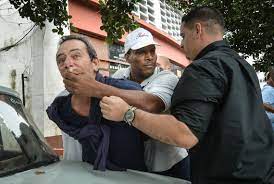
It also violates, says the organization, the rights to appoint a defender and communicate with relatives for the collection of evidence, “since the presentation of these by the accused is not guaranteed,” in addition to the principle of publicity to which all due process is obliged. . The “direct attestation” implies, refers CPD, “a lightning process, without communication to the interested parties and behind closed doors”, analogous “to the accusatio process of Ancient Rome”.
In a statement published this Saturday, the OCDH regretted that Josep Borrell, head of European diplomacy, and Michelle Bachelet, UN High Commissioner for Human Rights, “try to divert attention from the reasons for the massive protests in recent days. in Cuba”.
“There have been many requests in the demonstrations, but the phrases that were heard the most were ‘freedom’ and ‘we are not afraid.’ To attribute only the economic situation as the reason for the protests, as Mrs. Bachelet has done, is not to understand absolutely nothing that happens in Cuba, “says Alejandro González Raga, executive director of the organization, also based in Madrid.
José Daniel Ferrer Cantillo denounced that they beat all the people who entered the police station where they took him, “young people, old people, all those who managed to arrest that day”
In the same way, González Raga says that Borrell “is wrong to hold the United States responsible” and asserts: “These protests sum up 62 years of repression. It is Cuba that has to change. We must put the full focus on those responsible for what today Cuba is a dictatorship. External factors influence, but the problem is the dictatorship. ”
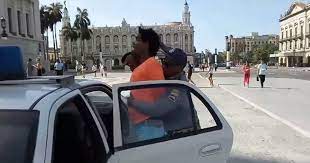
José Daniel Ferrer Cantillo, son of the Unpacu leader, was detained with his father on Sunday the 11th, before they could participate in the demonstration that was taking place in Santiago de Cuba, and released this Sunday, narrated in a video that They accused him of a crime of “inciting public disorder”, “propagation of epidemics” and “public disorder”, then “lowered”, as they informed him, “to public disorder nothing more”, for which they raised “an act of warning “and they told him that he had to promise not to participate in any march and to go sign every Tuesday at the Versailles police station.
By refusing, they threatened to impose provisional imprisonment, a measure to which his father is subjected. The young man also denounced that they beat all the people who entered the police station where they took him, “young people, old people, all those who managed to arrest that day” and that among the prisoners is a pregnant woman who is not the care you need.
Likewise, his father, he reports, was in an ulcer crisis when he left home, and that he is unwell. “There it is in the worst conditions in the world, that’s like a concentration camp.”
Agencies/ 14ymedio, La Habana/ Internet Photos/ Arnoldo Varona/ Videos/Photos> La Historia de Cuba
THE CUBAN HISTORY, HOLLYWOOD.
RECOMIENDENOS A SUS AMISTADES * PREFIERA A NUESTROS SPONSORS.