

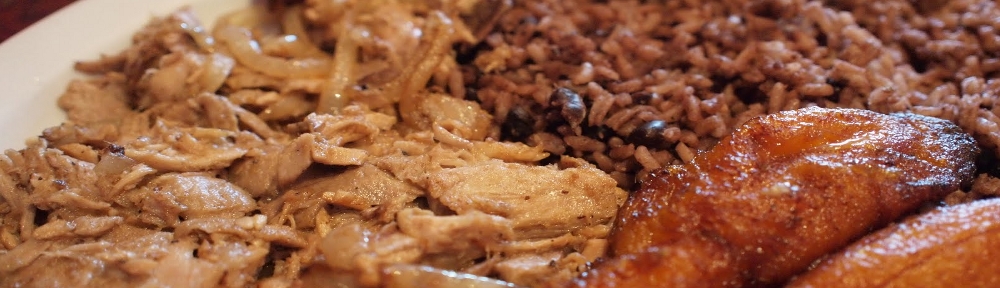

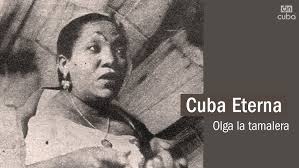
La cienfueguera Olga Moré Jiménez, fue la musa inspiradora del contagioso pregón popularizado por la inigualable Orquesta Aragón, escuchado en casi todo el mundo y versionado a muchos géneros y cantado por importantes artistas.
En la calle Figuras número 180 entre Manrique y Tenerife, barrio de Los Sitios, se levantaba esta mujer de tez negra, natural de Cienfuegos, quien abrumada por la situación familiar buscó una solución; esta mujer emprendedora y empoderada por su autenticidad se convirtió en una de esas personas que la han dado brillos a La Habana, mostrando la cubanía.
Olga había perdido a su esposo y tenía tres niños pequeños y una madre anciana. Cuando le vino la idea de hacer tamales para vender, se preguntó y ¿por qué no? Así que tomó una jaba casera confeccionada con retazos de vestidos y fue al mercado para iniciar su idea de sustento. De modo tal que se dijo: “Voy a ser la primera mujer que venda tamales en La Habana”. Luego de haber rayado el maíz, Olga se paraba frente a la gran cazuela, donde prefería estar sola. Porque para ella esa receta era y seguirá siendo un gran misterio para los cubanos.
OLGA LA TAMALERA
Coinciden los historiadores especializados en temas callejeros que Olga era una habitual de la céntrica esquina habanera donde confluyen las calles Prado y Neptuno, donde se escuchaban sus ingeniosos pregones para atraer a los clientes.
Este particular, unido a la calidad del producto, le fue granjeando popularidad a la vendedora, que pasaba largas horas en el arte de elaborar el suculento alimento a base de maíz tierno rayado, carne puerco y un sazón que solo ella conocía.
Su quehacer culinario alcanzó fama en toda Cuba y hasta en el extranjero.
Otras interpretación refieren que “Olga la tamalera”, como era conocida, no vendía por la calle, ni tocaba de puerta en puerta ya que era dueña de una categoría culinaria y la mercancía la ofrecía en su propio hogar y casi siempre por encargo.
Una vez retirada Olga More, varios negocios asumieron como nombre “Tamales Olga” y “Olga, la tamalera”.
INSPIRADORA EN LA MUSICA CUBANA
Un lugar frecuentado por Olga fueron los salones de bailes populares, donde alternaba la venta, con algún que otro pasillo, de acuerdo a las canciones de moda en aquella época y precisamente fue allí donde conoció al flautista pinareño José Antonio Fajardo.
Él era director de la Orquesta Fajardo y sus Estrellas, que ante el inconfundible sabor del manjar y la fama alcanzada por Olga, tuvo la gentileza de dedicarle una canción que tituló “Los tamalitos de Olga”, que derivó furor en la década del 50.
El pregón, devino éxito internacional, de la mano de Rafael Lay y su agrupación, gracias a sus giras por América Latina y más tarde en los Estados Unidos y parte de Europa, y no resulta difícil creer que en varios países se tarareara el estribillo.
La canción, que además rinde culto a uno de los platos más sabroso de la cocina cubana, grabada además por el proyecto Estrellas de Areíto, el cuarteto de saxofones Magic Sax Quartet y el venezolano Oscar D´León, acumula la fabulosa cifra de 160 versiones.
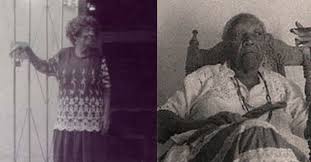
OLGA MORE “OLGA LA TAMALERA” INSPIRING MUSE OF A FAMOUS PREGON AND A CLASSIC CUBAN DISH. PHOTOS.
Olga Moré Jiménez, a native of Cienfuegos, was the inspiring muse of the contagious pregón (singing word) popularized by the incomparable Orquesta Aragón, heard almost all over the world and covered in many genres and sung by important artists.
At 180 Figuras Street between Manrique and Tenerife streets in the Los Sitios neighborhood, stood this dark-skinned woman from Cienfuegos. Overwhelmed by her family situation, she sought a solution. This enterprising woman, empowered by her authenticity, became one of those who have brought a shine to Havana, showcasing its Cuban identity.
Olga had lost her husband and had three young children and an elderly mother. When the idea of making tamales to sell came to her, she asked herself, “Why not?” So she grabbed a homemade bag made from scraps of dresses and went to the market to start her livelihood. So she said to herself, “I’m going to be the first woman to sell tamales in Havana.” After grating the corn, Olga would stand in front of the large pot, where she preferred to be alone. Because for her, this recipe was and will continue to be a great mystery to Cubans.
OLGA THE TAMALERA
Historians specializing in street food agree that Olga was a regular at the central Havana corner where Prado and Neptuno streets meet, where her clever cries could be heard to attract customers.
This particularity, coupled with the quality of the product, earned the vendor popularity, as she spent long hours preparing the succulent dish made from grated sweet corn, pork, and a seasoning that only she knew.
Her culinary work achieved fame throughout Cuba and even abroad.
Other interpretations suggest that “Olga the Tamale Maker,” as she was known, did not sell on the street or go door-to-door, as she owned a culinary category and offered her merchandise from her own home, almost always by order.
After Olga More retired, several businesses took the name “Tamales Olga” and “Olga, the Tamale Maker.”
INSPIRATION IN CUBAN MUSIC
Olga frequented popular dance halls, where she alternated selling with the occasional pasillo dance, to the songs popular at the time. It was there that she met the Pinar del Río flutist José Antonio Fajardo.
He was the director of the Fajardo y sus Estrellas Orchestra, and, given the unmistakable flavor of the delicacy and Olga’s fame, he was kind enough to dedicate a song to her, titled “Olga’s Tamales,” which became a hit in the 1950s.
The opening speech became an international hit, thanks to Rafael Lay and his group’s tours throughout Latin America and later the United States and parts of Europe. It’s not hard to believe that the chorus was hummed in several countries.
The song, which also pays tribute to one of the most delicious dishes in Cuban cuisine, was also recorded by the Estrellas de Areíto project, the Magic Sax Quartet saxophone quartet, and Venezuelan Oscar D’León, and has amassed a fabulous 160 versions.
Agencies/ Wiki/ OlgalaTamaleraHis./ Ecured/ Internet Photos/ Arnoldo Varona.
www.TheCubanHistory.com
THE CUBAN HISTORY, HOLLYWOOD.

