


LA NOCHEBUENA CUBANA EN EL RECUERDO DE UN PASADO MEJOR. PHOTOS.
Las fiestas navideñas y de Año Nuevo son las celebraciones más esperadas cada año en la mayor parte del mundo. Se calcula que en unos 150 países, con mayor énfasis en los que están más arraigadas la tradición y la cultura cristianas. Y por lo general, la cena de Nochebuena, el 24 de diciembre, víspera de la Navidad, es el foco principal de dichas fiestas tradicionales en homenaje al nacimiento de Jesucristo. Lo es por su carácter familiar, a diferencia de la espera del Año Nuevo, que es una fiesta menos íntima, más pública y “callejera”.
En Cuba, luego de la introducción del ganado porcino, llevado por Colón al Caribe en su segundo viaje a “las Indias” (1493), poco después de la colonización de la Isla la carne de puerco se hizo indispensable en las grandes fiestas y muy particularmente en la Nochebuena, siguiendo la costumbre de esa celebración tradicional en España desde el siglo XVI.
En Cuba, se celebraba la Nochebuena y después se concurría a la Misa de Gallo. Pero a partir de 1969 las fiestas fueron eliminadas oficialmente y no fue hasta la visita del Papa Juan Pablo II y hasta diciembre de 1997, que se volvió a declarar el 25 de diciembre como día feriado no laborable. No obstante durante esos 28 años en muchos hogares cristianos se adoraba en la intimidad el nacimiento del Niño Jesús, y se recordaban a los Reyes Magos del Oriente.
Pero lo que si nunca dejó de celebrarse, de una u otra forma, fue la Nochebuena. Y los cubanos con esfuerzo, esa noche ponían en su mesa todo lo mejor que podían conseguir, que para eso estaba el mercado negro…
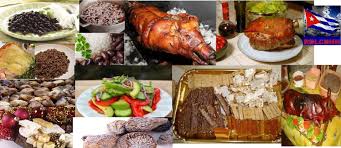
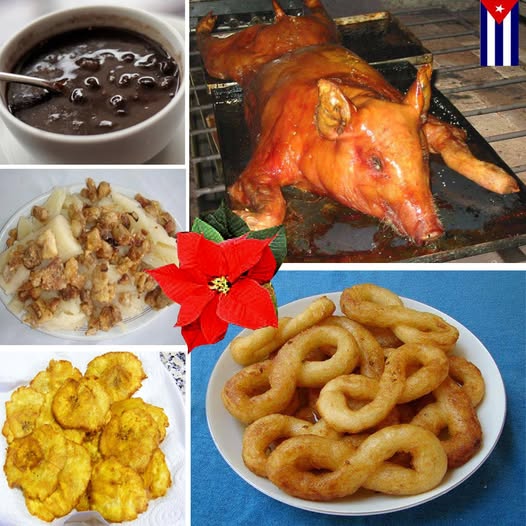
La comida tradicional de las mesas el 24 de diciembre era el lechón asado, arroz congrí o arroz y frijoles, viandas (yuca, malanga, boniato) con mojo criollo a base de naranja agria, grasa de puerco y mucho ajo. También acompañaban ensaladas o plátanos fritos maduros o verdes en versión de mariquitas o tostones. Los postres, algún que otro dulce en almíbar con queso criollo o los buñuelos, que con tanto esmero hacían nuestras abuelas, en forma de ocho, y que elaboraban a partir de una masa de harina, huevo y varios tubérculos. Al servirlos se bañaban con una almíbar hecha de azúcar y anís.
La fiesta comenzaba desde la noche del 23, cuando las madres adobaban el lechón y ponían en remojo los frijoles negros. En la mañana del 24, muy temprano, en el campo, o en casas con patio, se cocinaba al pincho o sobre un bastidor de metal improvisado. Se preparaba el “horno” en la tierra y se procedía al asado, ya fuese “al pincho” o sobre un bastidor de metal improvisado. El puerco se colocaba sobre una camada de hojas de guayaba, labor casi siempre a cargo del hombre de la casa y de los hijos varones. Y por supuesto acompañada esta labor por abundante cerveza.
EL LECHON, EL CENTRO DE LA COMIDA
El lechón era el anfitrión de la comida y cocinarlo era todo un ritual. Se asaba la pieza o el animal entero según eran las posibilidades económicas. Mientras se asaba, se untaba con mojo para que adquiriese ese sabor que cuesta olvidar. Ese adobo que permite el sabor y olor tan característico de la Nochebuena cubana. Y aunque cada familia poseía su «mojo especial», era común la naranja agria, especias y sal. Al menos yo no conozco mejor aliño que la tradicional mezcla de ajo y sal en el mortero, para tener al final esa pasta media blanca-amarillenta, y entonces sumarlo al jugo de la naranja agria con algo de pimienta negra molida y hojas de laurel…
En la parte occidental de la Isla, tenían un invento, «la caja cubana» y es una de las pocas formas de asado en que el carbón o braza va encima y no debajo de la carne, y ambos cerrados casi herméticos y mejor aun enterrados, y es también como mejor queda la piel del lechón y es algo para chuparse los dedos, por lo crujiente y suave de la piel al terminar.
En otros casos, el lechón era llevado a las panaderías, quienes por un mínimo precio, lograban en sus hornos una cocción perfecta. Aunque realmente el placer era hacerlo en casa y eso formaba parte de la tradición y la fiesta de ese día…
Las tradiciones Navideñas eran parte del patrimonio religioso y cultural de nuestro pueblo, y estaban arraigadas en su memoria histórica. Era la temporada festiva más esperada por los cubanos. Por su aceptación casi universal, la Navidad es la única celebración que impone normas idénticas a gentes de diversas culturas, idiomas y razas.
A pesar de la influencia norteamericana, la Navidad en Cuba se celebraba a la española, por la influencia de nuestros antepasados: con Nochebuena y los Tres Reyes Magos. Eran días mágicos de planeamiento; de compras de víveres y regalos para disfrutarlos con familiares y amigos; del envío de tarjetas postales; de la decoración festiva de nuestros hogares, tiendas, calles y ciudades, rebosantes de luces y colores.
La cena de Nochebuena era una de las fiestas familiares más importante del año, y sea una cena íntima entre pocas personas, o una enorme fiesta familiar, era una ocasión para reunir la familia, sentarnos juntos, conversar, vernos. Y eso recuerdos son imposibles de olvidar…

CUBAN CHRISTMAS EVE IN MEMORY OF A BETTER PAST. PHOTOS.
The Christmas and New Year holidays are the most anticipated celebrations every year in most of the world. It is estimated that in about 150 countries, with greater emphasis on those where Christian tradition and culture are more deeply rooted. And generally, Christmas Eve dinner, on December 24, Christmas Eve, is the main focus of these traditional celebrations in honor of the birth of Jesus Christ. It is so because of its family nature, unlike the wait for the New Year, which is a less intimate, more public and “street” celebration.
In Cuba, after the introduction of pigs, brought by Columbus to the Caribbean on his second voyage to “the Indies” (1493), shortly after the colonization of the Island, pork became indispensable in the great celebrations and particularly on Christmas Eve, following the custom of that traditional celebration in Spain since the 16th century.
In Cuba, Christmas Eve was celebrated and then people attended Midnight Mass. But from 1969 onwards the celebrations were officially eliminated and it was not until the visit of Pope John Paul II and until December 1997, that December 25 was again declared a non-working holiday. Nevertheless, during those 28 years in many Christian homes the birth of the Child Jesus was privately adored, and the Three Wise Men from the East were remembered.
But what never stopped being celebrated, in one way or another, was Christmas Eve. And the Cubans, with great effort, put on their tables that night the best they could get, because that’s what the black market was for…
The traditional food on the tables on December 24th was roast suckling pig, congrí rice or rice and beans, vegetables (cassava, malanga, sweet potato) with a Creole sauce made of sour orange, pork fat and lots of garlic. They also accompanied salads or fried ripe or green plantains in the form of mariquitas or tostones. The desserts were some sweets in syrup with Creole cheese or fritters, which our grandmothers made with such care, in the shape of an eight, and which they made from a dough of flour, egg and various tubers. When serving them, they were bathed in a syrup made of sugar and anise.
The party began on the night of the 23rd, when the mothers marinated the suckling pig and soaked the black beans. On the morning of the 24th, very early, in the countryside, or in houses with patios, the food was cooked on a skewer or on an improvised metal frame. The “oven” was prepared in the ground and the roasting was carried out, either “on a skewer” or on an improvised metal frame. The pig was placed on a layer of guava leaves, a task almost always carried out by the man of the house and the male children. And of course, this task was accompanied by abundant beer.
THE PIG, THE CENTER OF THE MEAL
The pig was the host of the meal and cooking it was a ritual. The whole piece or the entire animal was roasted depending on the economic possibilities. While it was roasting, it was covered with mojo so that it acquired that flavor that is hard to forget. That marinade that allows the flavor and smell so characteristic of Cuban Christmas Eve. And although each family had its “special mojo,” bitter orange, spices and salt were common. At least I don’t know of a better seasoning than the traditional mixture of garlic and salt in a mortar, to have that yellowish-white paste at the end, and then add it to the juice of the bitter orange with some ground black pepper and bay leaves…
In the western part of the Island, they had an invention, “the Cuban box” and it is one of the few ways of roasting where the charcoal or embers go on top and not under the meat, and both are almost hermetically sealed and even better buried, and it is also how the skin of the pig is best and it is something to lick your fingers, because of how crispy and soft the skin is when finished.
In other cases, the pig was taken to bakeries, who for a minimal price, achieved perfect cooking in their ovens. Although the real pleasure was to do it at home and that was part of the tradition and the celebration of that day…
Christmas traditions were part of the religious and cultural heritage of our people, and were rooted in their historical memory. It was the festive season most awaited by Cubans. Because of its almost universal acceptance, Christmas is the only celebration that imposes identical norms on people of different cultures, languages and races.
Despite the North American influence, Christmas in Cuba was celebrated in the Spanish way, due to the influence of our ancestors: with Christmas Eve and the Three Wise Men. They were magical days of planning; of buying groceries and gifts to enjoy with family and friends; of sending postcards; of the festive decoration of our homes, stores, streets and cities, overflowing with lights.
Agencies/ Wiki/ NostalgiaCubana/ Derubin Jacome/ Roberto Alvarez/ Extractos/ Excerpts/ Arnoldo Varona.
TheCubanHistory.com
THE CUBAN HISTORY, HOLLYWOOD.
