


EL NUEVO SISTEMA DE REMESAS A CUBA SERÁ UN “MISIL FINANCIERO” EN MANOS DE LOS CUBANOS
La plataforma permite realizar pagos digitales entre personas que tengan esta aplicación y los que tengan la tarjeta de débito. Emilio Morales, presidente de la firma de asesoría Havana Consulting Group y vicepresidente de la subsidiaria estadounidense de RevoluGROUP, indicó en rueda de prensa en Miami que su aplicación móvil RevoluSend envía el dinero al beneficiario eludiendo las empresas de la lista de entidades cubanas restringidas por EEUU.

Emilio Morales, presidente de la firma de asesoría Havana Consulting Group y vicepresidente de la subsidiaria estadounidense de RevoluGROUP. (14ymedio)
La empresa canadiense RevoluGROUP, que en febrero pasado comenzó a operar para el envío de remesas a Cuba, aseguró este martes que este dinero entra “limpio” en la Isla a través de su aplicación móvil y se cuela así por las “grietas” del sistema del régimen castrista.
Emilio Morales, presidente de la firma de asesoría Havana Consulting Group y vicepresidente de la subsidiaria estadounidense de RevoluGROUP, indicó en rueda de prensa en Miami que su aplicación móvil RevoluSend envía el dinero al beneficiario eludiendo las empresas de la lista de entidades cubanas restringidas por EEUU.
Este sistema permite realizar pagos digitales entre personas que tengan esta aplicación y los que tengan la tarjeta de débito que también ofrecen pueden sacar dinero en cajeros automáticos afiliados a Visa y Mastercard.
Permite además depositar el dinero recibido en tres entidades financieras cubanas, el Banco Popular de Ahorro, el Banco de Crédito y Comercio o en el Banco Metropolitano.
Explicó que la economía cubana ha sufrido en los últimos años debido a la pandemia, que provocó la caída abrupta de la llegada de turistas y visitantes que llevaban dinero a sus familiares, y las sanciones de EE UU que cerraron el grifo a las remesas desde el país del norte.
Desde noviembre de 2020, las remesas hacia Cuba se han paralizado de facto después de que la Administración del entonces presidente norteamericano, Donald Trump, prohibiera cualquier transacción desde Estados Unidos con la estatal cubana Fincimex, controlada por militares y que trabajaba de la mano con Western Union.
“RevoluGROUP no tiene contrato mercantil con el Gobierno cubano, ni va tenerlo”
Morales insistió en que Revolugroup, quien recibió el visto bueno del Departamento del Tesoro de EE UU, “absolutamente no tiene nada que ver” con el Gobierno cubano ni las corporaciones públicas en la isla.

“RevoluGROUP no tiene contrato mercantil con el Gobierno cubano, ni va tenerlo”, destacó Morales, que explicó que en los otros 115 países donde operan en ningún caso las administraciones les han pedido firmar acuerdos de este tipo, porque en la Isla lo que quieren es “meter la mano en la masa de dinero que llega y robársela”.
En su opinión, la “práctica abusiva” de pasar por el sistema oficial es la forma en la que el Gobierno cubano tiene de “quedarse con las remesas”, pues se quedan con los dólares.
El Banco Central de Cuba confirmó la pasada semana que RevoluGROUP no ha firmado contrato alguno e indicó que se desconoce la “formalidad” y “seguridad” de sus transacciones.
En este sentido, Morales, quien rehusó revelar cuánto dinero se ha mandado a la Isla desde que empezó a funcionar el sistema el pasado 28 de febrero, agradeció la “publicidad no pagada”, pues, dijo, miles de personas empezaron a descargar la aplicación cuando el Banco de Cuba les tachó de inseguros.
El economista Emilio Morales destacó que ahora todos los cubanos tienen la oportunidad de tener en sus manos un “misil financiero” con el que recibir y pagar dinero de manera digital.
LA DIASPORA CUBANA
La diáspora cubana en los Estados Unidos comprende casi 2,7 millones de personas que nacieron en Cuba o informaron ascendencia o raza cubana, según tabulaciones de la Oficina del Censo de los Estados Unidos. Alrededor de la mitad de la diáspora cubana vive en Florida. Otras poblaciones importantes de la diáspora cubana en todo el mundo son: España (141 400), Italia (37 300), Canadá (19 000), Alemania (13 400) y México (12 900), según estimaciones de la División de Población de las Naciones Unidas de mediados de 2019.
Las remesas, en su mayoría de cubanoamericanos, hasta 2020 canalizaron más de $3 mil millones de dólares al año en la economía de Cuba. El servicio de Western Union se suspendió en noviembre de 2020 y anteriormente controlaba alrededor del 30% del mercado. Durante los actuales acontecimientos políticos en los EE. UU., que llevaron a un endurecimiento del embargo, ya no es posible enviar remesas a Cuba con los principales proveedores estadounidenses.
Desde la salida de Western Union y otras entidades estadounidenses de la isla y los efectos de la pandemia del COVID19, se estima que Cuba recibió apenas $1,900 millones de dólares en 2021, $1,100 millones menos que en 2020, principalmente por la ausencia, como se mencionó anteriormente , de los mecanismos de cumplimiento de los Estados Unidos.
Morales rehusó revelar cuánto dinero se ha mandado a la Isla desde que empezó a funcionar el sistema el pasado 28 de febrero.
Morales insinuó que el Gobierno cubano está maniatado pues se metería en un “gran problema” con Visa, Mastercard y el sistema internacional de datos bancarios Swift si rechaza la llegada de las transferencias, pues actualmente estas son tres de las principales vías de divisas que tiene la Isla actualmente.
“Sería el fin del régimen en dos meses” indicó.
Trump prohibió en noviembre de 2020 el envío de remesas a Cuba, una medida con la que EE UU aumentó rápidamente el ahogo económico a la Isla y que Biden ha mantenido durante su primer año en el poder, aunque hace más de seis meses anunció que su Gobierno estudia cómo volver a autorizar los envíos para que el dinero “llegue directamente a las manos del pueblo cubano”.
El Departamento de Estado sancionó primero a Financiera Cimex S.A. (Fincimex) y después a la empresa American International Services S.A. (AIS), ambas pertenecientes a la corporación Cimex. Estas sanciones trataron de persuadir al Gobierno cubano de que tenían que apartar a los militares del negocio de las remesas.
En ausencia de datos del Banco Central de Cuba, los investigadores estiman que el total de remesas enviadas desde Estados Unidos a Cuba está entre 2.000 y 4.000 millones de dólares anuales.
Las autoridades cubanas arremetieron este jueves contra la empresa canadiense RevoluGROUP, que habilitó esta semana el envío de remesas a Cuba sin que estas pasen por las manos del conglomerado militar GAESA, al acusarla de tener un mayor costo para los cubanos.
Pese a que el Gobierno de la Isla ha condenado en numerosas ocasiones la prohibición del envío de remesas a través de empresas como Western Union, que utilizaba como contraparte a FINCIMEX, perteneciente a los militares cubanos, se quejó de la aprobación del envío de dinero a Cuba a través de la entidad canadiense RevoluGROUP.

RECOMIENDENOS A SUS AMISTADES * PREFIERA A NUESTROS SPONSORS.

THE NEW SYSTEM OF REMITTANCES TO CUBA WILL BE A “FINANCIAL MISSILE” IN THE HANDS OF THE CUBANS
The platform allows digital payments to be made between people who have this application and those who have a debit card. Emilio Morales, president of the consulting firm Havana Consulting Group and vice president of the US subsidiary of RevoluGROUP, indicated at a press conference in Miami that his mobile application RevoluSend sends the money to the beneficiary avoiding companies on the list of Cuban entities restricted by the US.
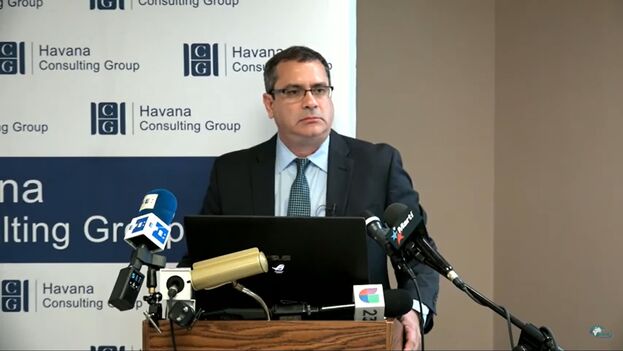
Emilio Morales, president of the firm consultancy Havana Consulting Group and vice president of the US subsidiary of RevoluGROUP. (14ymedio)
The Canadian company RevoluGROUP, which last February began operating to send remittances to Cuba, assured this Tuesday that this money enters the island “clean” through its mobile application and thus slips through the “cracks” of the system. of the Castro regime.
Emilio Morales, president of the consulting firm Havana Consulting Group and vice president of the US subsidiary of RevoluGROUP, indicated at a press conference in Miami that his mobile application RevoluSend sends the money to the beneficiary avoiding companies on the list of Cuban entities restricted by the US.
This system allows digital payments to be made between people who have this application and those who have the debit card that they also offer can withdraw money at ATMs affiliated with Visa and Mastercard.
It also allows depositing the money received in three Cuban financial entities, the Banco Popular de Ahorro, the Banco de Crédito y Comercio, or the Banco Metropolitano.
He explained that the Cuban economy has suffered in recent years due to the pandemic, which caused the abrupt drop in the arrival of tourists and visitors who brought money to their relatives, and the US sanctions that have closed the tap on remittances since the north country.
Since November 2020, remittances to Cuba have been de facto paralyzed after the administration of the then US president, Donald Trump, prohibited any transaction from the United States with the Cuban state-owned Fincimex, controlled by the military and which worked for hand in hand with Western Union.
“RevoluGROUP does not have a commercial contract with the Cuban Government, nor will it have one”
Morales insisted that Revolugroup, which received the approval of the US Treasury Department, “has absolutely nothing to do” with the Cuban government or public corporations on the island.
“RevoluGROUP does not have a commercial contract with the Cuban government, nor is it going to have one,” said Morales, who explained that in the other 115 countries where they operate, in no case have the administrations asked them to sign agreements of this type, because on the island what they want it is “to put the hand in the mass of money that arrives and to steal it”.

In his opinion, the “abusive practice” of going through the official system is the way in which the Cuban government has to “keep the remittances” since they keep the dollars.
The Central Bank of Cuba confirmed last week that RevoluGROUP has not signed any contract and indicated that the “formality” and “security” of its transactions are unknown.
In this sense, Morales, who refused to reveal how much money has been sent to the island since the system began operating on February 28, thanked the “unpaid advertising”, because, he said, thousands of people began to download the application when the Bank of Cuba branded them as insecure.
The economist Emilio Morales stressed that now all Cubans have the opportunity to have in their hands a “financial missile” with which to receive and pay money digitally.
THE CUBAN DIASPORA
The Cuban diaspora in the United States comprises nearly 2.7 million people who were born in Cuba or reported Cuban ancestry or race, according to tabulations from the US Census Bureau. About half of the Cuban diaspora lives in Florida. Other important populations of the Cuban diaspora around the world are Spain (141,400), Italy (37,300), Canada (19,000), Germany (13,400), and Mexico (12,900), according to estimates by the Population Division of the United Nations in mid-2019.
Remittances, mostly from Cuban-Americans, through 2020 funneled more than $3 billion a year into Cuba’s economy. Western Union’s service was discontinued in November 2020 and previously controlled around 30% of the market. During the current political events in the US, which led to a tightening of the embargo, it is no longer possible to send remittances to Cuba with the main US suppliers.
Since the departure of Western Union and other US entities from the island and the effects of the COVID19 pandemic, it is estimated that Cuba received just $1.9 billion dollars in 2021, $1.1 billion less than in 2020, mainly due to the absence, as mentioned above, of the United States enforcement mechanisms.
Morales refused to reveal how much money has been sent to the island since the system began operating on February 28.
Morales insinuated that the Cuban government is handcuffed because it would get into a “big problem” with Visa, Mastercard, and the Swift international banking data system if it rejects the arrival of transfers since these are currently three of the main foreign exchange channels that it has the island today.
“It would be the end of the regime in two months,” he indicated.
In November 2020, Trump prohibited the sending of remittances to Cuba, a measure with which the United States rapidly increased the economic suffocation on the Island and which Biden has maintained during his first year in power, although more than six months ago he announced that his The government is studying how to reauthorize shipments so that the money “reaches directly into the hands of the Cuban people.”
The State Department first sanctioned Financiera Cimex S.A. (Fincimex) and later to the company American International Services S.A. (AIS), both belonging to the Cimex corporation. These sanctions tried to persuade the Cuban government that they had to get the military out of the remittance business.
In the absence of data from the Central Bank of Cuba, the researchers estimate that the total remittances sent from the United States to Cuba are between 2,000 and 4,000 million dollars annually.
The Cuban authorities attacked this Thursday against the Canadian company RevoluGROUP, which this week enabled the sending of remittances to Cuba without them passing through the hands of the GAESA military conglomerate, accusing it of having a higher cost for Cubans.
Despite the fact that the Government of the Island has condemned on numerous occasions the prohibition of sending remittances through companies such as Western Union, which used FINCIMEX, which belongs to the Cuban military, as its counterparty, it complained about the approval of sending money to Cuba through the Canadian entity RevoluGROUP.
Agencies/ 14yMedio/ RevoluGROUPCanada/ Extractos/ Excerpts/ Internet Photos/ Arnoldo Varona/ www.TheCubanHistory.com
THE CUBAN HISTORY, HOLLYWOOD.

RECOMIENDENOS A SUS AMISTADES * PREFIERA A NUESTROS SPONSORS.