– PRESIDENT OF CUBA meets North American Agricultural Entrepreneurs. <> PRESIDENTE DE CUBA se reune con Empresarios Agricolas Norteamericanos. FOTOS.

Diaz-Canel-y-Consejo-Nacional-de-Iglesias-de-EEUU-e-n-NY-580x338PRESIDENT OF CUBA MEETS NORTH AMERICAN AGRICULTURAL ENTREPRENEURS.

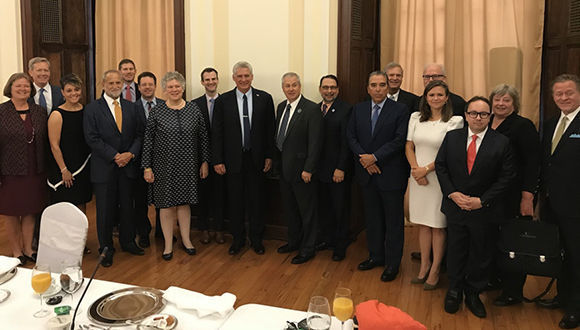
The new president of Cuba Miguel Díaz-Canel met Thursday in New York with executives and American businessmen linked to the agricultural sector, whom he invited not to waste a market of 11 million people, the population of Cuba.

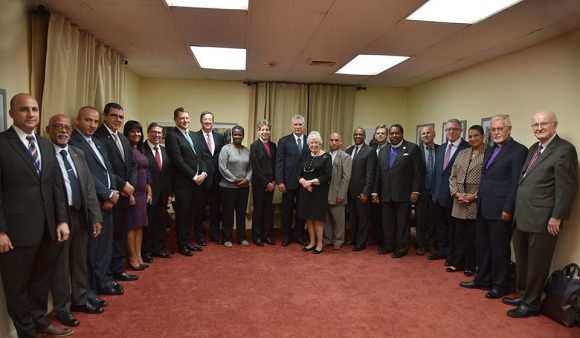
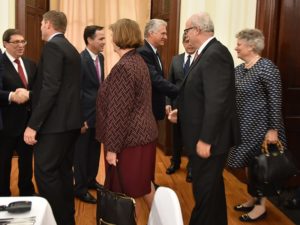
The meeting with Díaz-Canel was attended by Jeff Witte, president of the National Association of Departments of Agriculture (NASDA) and Secretary of Agriculture of New Mexico, the commissioners of Agriculture of Virginia and Connecticut, Jewel Bronaugh and Steve Reviczky, and the executive director of NASDA, Barbara P. Glenn, said the official site Cubadebate.

“We fully support the improvement of agricultural trade and cooperation with Cuba, and we believe that the current US embargo should be lifted,” Witte said. “Many state agricultural officials have existing relationships in Cuba, and we are here today to forge and improve new partnerships between NASDA members and Cuban officials, particularly in agriculture,” he added.

Managers want more exchanges on research and biotechnological knowledge, as well as cooperation in sanitary and phytosanitary issues.

The Cuban government, which is experiencing liquidity problems, imports between 60% and 70% of the food it consumes, which each year costs the state coffers about 2,000 million dollars, according to official data.
cuban-president

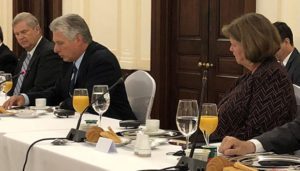
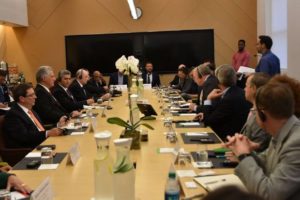
“When we buy food, we are thinking of 11 million, which is the entire Cuban population,” Díaz-Canel told the delegation. “11 million people is not a market to be squandered,” the president added at the meeting held at the Permanent Mission of Cuba to the United Nations. “Buy foods, which are known to be of very good quality, produced by you, for us would represent facilities and opportunities,” added the president.

Diaz-Canel declared himself “open to dialogue” with the current Administration of Donald Trump, contrary to the approach favored by his predecessor, Barack Obama, and insisted that the current setback in bilateral relations is linked to the interests of “a minority that deals to stop the approaches “. He also considered that an exchange with the American agricultural sector would allow the transfer of technology and increase some local productions and could even be extended to the scientific order in a “mutually beneficial” way. “Cuba imports annually more than 2,000 million dollars in food with countries that are at a great distance and that makes everything expensive,” complained Díaz-Canel.
cuban-president-group-photo

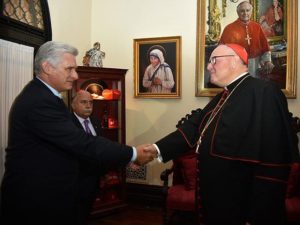
Diaz-Canel also spoke Thursday for more than half an hour with the New York archbishop, Timothy Michael Dolan, at the headquarters of the Cathedral of St. Patrick, in Manhattan, “in an atmosphere of cordiality,” according to the official Prensa Latina.

Since his arrival in power last April, it has not transpired that there has been any meeting of the Cuban president with authorities of the Catholic Church of the island, although images of the president were circulated in the sanctuary of El Cobre, when he visited Santiago de Cuba.

After arriving in the United States last Sunday, the president has developed a marathon agenda that has included meetings with other presidents, US authorities and business representatives.

logo

Diaz-Canel-reunión-en-google-580x387PRESIDENTE DE CUBA SE REUNE CON EMPRESARIOS AGRICOLAS NORTEAMERICANOS.

El Nuevo presidente de Cuba Miguel Díaz-Canel se reunión este jueves en Nueva York con directivos y empresarios estadounidenses vinculados al sector agrícola a quienes invitó a no desaprovechar un mercado de 11 millones de personas, la población de Cuba.

Al encuentro con Díaz-Canel acudieron Jeff Witte, presidente de la Asociación Nacional de Departamentos de Agricultura (NASDA) y secretario de Agricultura de Nuevo México, los comisionados de Agricultura de Virginia y Connecticut, Jewel Bronaugh y Steve Reviczky, y la directora ejecutiva de NASDA, Barbara P. Glenn, precisó el sitio oficial Cubadebate.

“Apoyamos plenamente la mejora del comercio agrícola y la cooperación con Cuba, y creemos que el actual embargo de EEUU debería ser levantado”, dijo Witte. “Muchos funcionarios agrícolas estatales tienen relaciones existentes en Cuba, y estamos aquí hoy para forjar y mejorar nuevas asociaciones entre los miembros de NASDA y los funcionarios cubanos, particularmente en la agricultura”, añadió.

Los directivos quieren más intercambios sobre investigación y conocimiento biotecnológico, así como la cooperación en cuestiones sanitarias y fitosanitarias.

El Gobierno cubano, que atraviesa problemas de liquidez, importa entre el 60% y el 70% de los alimentos que consume, lo que cuesta cada año a las arcas estatales unos 2.000 millones de dólares, según datos oficiales.
diaz-canel-encuentro-sector-agricola-eeuu-estudios-revolucion

“Cuando compramos alimentos, estamos pensando en 11 millones, que es toda la población cubana”, dijo Díaz-Canel a la delegación. “11 millones de personas no es un mercado a desaprovechar”, añadió el mandatario en el encuentro celebrado en la Misión Permanente de Cuba ante las Naciones Unidas. “Comprar alimentos, que se conocen son de muy buena calidad, producidos por ustedes, para nosotros representaría facilidades y oportunidades”, añadió el gobernante.

Díaz-Canel se declaró “abierto al diálogo” con la actual Administración de Donald Trump, contraria al acercamiento propiciado por su antecesor, Barack Obama, e insistió en que el retroceso actual en las relaciones bilaterales está vinculado con intereses de “una minoría que trata de frenar los acercamientos”. También consideró que un intercambio con el sector agrícola estadounidense permitiría la transferencia de tecnología e incrementar algunas producciones locales e incluso podría ampliarse al orden científico de forma “mutuamente beneficiosa”. “Cuba importa anualmente más de 2.000 millones de dólares en alimentos con países que están a enorme distancia y eso encarece todo”, se quejó Díaz-Canel.
Miguel-Díaz-Canel-se-reúne-con-el-Arzobispo-de-Nueva-York-580x435

Díaz-Canel también conversó este jueves durante más de media hora con el arzobispo neoyorquino, Timothy Michael Dolan, en la sede de la Catedral de San Patricio, en Manhattan, “en un ambiente de cordialidad”, según recogió la oficial Prensa Latina.

Desde su llegada al poder en abril pasado, no ha trascendido que haya tenido lugar ninguna reunión del presidente cubano con autoridades de la Iglesia Católica de la Isla, aunque circularon imágenes del mandatario en el santuario de El Cobre, cuando visitó Santiago de Cuba.

Tras llegar a Estados Unidos el pasado domingo, el gobernante ha desarrollado una maratoniana agenda que ha incluido reuniones con otros presidentes, autoridades estadounidenses y representantes empresariales.

Agencies/ DDC/ Internet Photos/ Extractos/ Arnoldo Varona/ TheCubanHistory.com
THE CUBAN HISTORY HOLLYWOOD.
logo

cuba_1

– MERCADERES STREET, La Havana and the Unprecedented “Mural of the Personalities”. <> LA CALLE MERCADERES, Habana y él sin Precedentes “Mural de las Personalidades”. FOTOS.

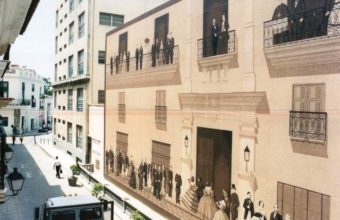
2651-mural-mercaderes1THE MERCADERES STREET, LA HAVANA AND THE UNPRECEDENTED ‘MURAL OF THE PERSONALITIES’.

Mercaderes Street (Calle Mercaderes) is one of the best preserved streets in the historic center of the capital of Cuba. Narrow, cobbled and pedestrian in which stand the immense doors of precious woods, canopies and old lamps.

We can easily walk its four blocks of extension, start at Tacón Street near the Cathedral of Havana and ends at the historic Plaza Vieja. Today, it is populated by museums, shops, restaurants and social projects, which is almost a replica of the original street dating from the 18th century.

From there, it inherits its name as a reflection of the immense commercial movement in the establishments of fine fabrics, gold, silver and other goods disposed in them to consume by the Habaneros of the time.

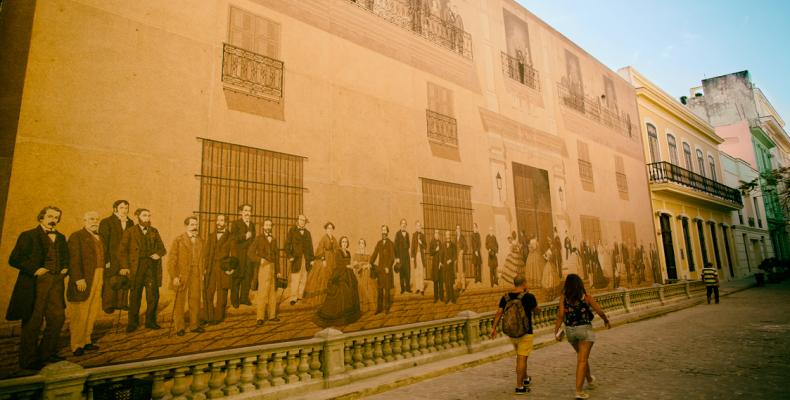
The transfer does not diminish, but it is difficult to travel by Mercaderes between O’Reilly and Empedrado and not stop before the “Mural of the Personalities” that pays tribute to the illustrious of the nineteenth century there perpetuated.

The mural was erected on an old stone wall that degraded the view of the centenary artery and is a faithful copy of the former palace of the Marquis of Arcos, headquarters of the Artistic and Literary Lyceum of Havana around 1844, an institution that the work vivifies, a place that welcomed the most select personalities of Cuban culture.

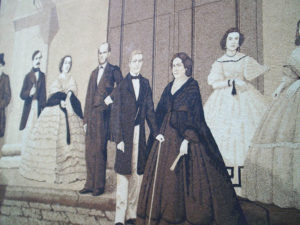
In the work of the Mural, imaginary scene of walk, in front of the facade of the Palace of the Marquis of Arcos, appear the illustrated independentistas warriors Carlos Manuel de Céspedes, the “Father of the Fatherland” for the Cubans, Gertrudis Gómez de Avellaneda, the Bishop Sword, the Countess of Merlin; Brindis de Salas (only once, at ten years old, he played in his salons) and the poet Placido, both excluded by the color of their skin.

auto-con-dos-frentes-indonesia-toyota-1920-4-1-340x220

The author, Andrés Carrillo, made a thorough research beforehand about the time and used in it a novel material in Cuba that includes a natural stone texture prepared to a specific grain size and embedded in acrylic resin. The mural also had the work of the architect Jaime Rodríguez, the sculptor Nicolás Ramos Guiardinú, several students of the San Alejandro School and some institutions.

Of great strength and durability in the open air and time, with four colors (brown, coral pink, black and light beige) it obtained a tonal range of 13 tints that gave it a perfect finish to “draw” the illustrious.

The plastic work concluded on December 27 of the year 2000, (approximately 300m² and composed of 52 panels) and reproduces in full size and accurately the 67 figures that make it up.

Not all the important personalities coincide exactly with the time that is recreated, some were proposed by the Historian of the City, Eusebio Leal Spengler, so that this amalgam pays homage to the national culture and our homeland history. With the irruption of what would be the Ten Years’ War, in 1868, the polarization of opinions and the increase in the repression of opposition political activities, the Liceo began to languish, as several of the members of its board of directors emigrated. and others declared themselves supporters of the pro-independence formula, and finally closed its doors in April 1869.

A work, the imposing mural. “Unprecedented in the Cuban mural” for being exposed to passers-by and a lesson in history, according to its author.

logo

07f7773930258be9550b286ecafa3a37LA CALLE MERCADERES, HABANA Y ÉL SIN PRECEDENTES “MURAL DE LAS PERSONALIDADES”.

La Calle Mercaderes es una de las calles mejor conservada del núcleo histórico de la capital de Cuba. Estrecha, adoquinada y peatonal en la que destacan las inmensas puertas de maderas preciosas, tejadillos y antiguas lámparas.

Podemos recorrer fácilmente sus cuatro cuadras de extensión, inicia en la Calle Tacón cerca de la Catedral de La Habana y termina en la histórica Plaza Vieja. En la actualidad la pueblan museos, tiendas, restaurantes y proyectos sociales, lo cual constituye casi una réplica de la calle original que data del siglo XVIII.

De ahí hereda su nombre como reflejo del inmenso movimiento comercial en los establecimientos de tejidos finos, oro, plata y otras mercaderías dispuestos en ellos para consumir por los habaneros de la época.

El trasiego no disminuye, pero resulta difícil transitar por Mercaderes entre O’Reilly y Empedrado y no detenernos ante el “Mural de las Personalidades” que rinde homenaje a los ilustres del silgo XIX allí perpetuados.

Calle-Mercaderes

El mural se levantó sobre un añejo muro de piedra que degradaba la vista de la centenaria arteria y es copia fiel del otrora palacio del Marqués de Arcos, sede del Liceo Artístico y Literario de La Habana hacia 1844,institución que la obra vivifica, lugar que acogió a lo más selecto de las personalidades de la cultura cubana.

En la obra del Mural, imaginaria escena de paseo, frente a la fachada del Palacio del Marqués de Arcos, aparecen los ilustrados guerreros independentistas Carlos Manuel de Céspedes, el “Padre de la Patria” para los cubanos, Gertrudis Gómez de Avellaneda, el Obispo Espada, la Condesa de Merlín; Brindis de Salas (una sola vez, a los diez años, tocó en sus salones) y el poeta Plácido, ambos excluidos por el color de su piel.

El autor, Andrés Carrillo hizo previo a su realización un minucioso trabajo de investigación sobre la época y utilizó en ella un material novedoso en Cuba que incluye una textura de piedra natural preparada a una medida del grano específica y embebida en resina acrílica. El mural, además, contó con el trabajo del arquitecto Jaime Rodríguez, el escultor Nicolás Ramos Guiardinú, varios alumnos de la Escuela de San Alejandro y algunas instituciones.

De gran resistencia y durabilidad a la intemperie y el tiempo, con cuatro colores (marrón, rosa coral, negro y beige claro) obtuvo una gama tonal de 13 tintes que le dieron un acabado perfecto para “dibujar” a los ilustres.

La obra plástica concluyó el 27 de diciembre del año 2000, (aproximadamente 300m² y compuesto por 52 paneles) y reproduce en tamaño natural y con exactitud a las 67 figuras que la integran.

MURAL 2

No todas las importantes personalidades coinciden exactamente con la época que se recrea, algunas fueron propuestas por el Historiador de la Ciudad, Eusebio Leal Spengler, para que esta amalgama brinde homenaje a la cultural nacional y nuestra historia patria. Con la irrupción de la que sería la Guerra de los Diez Años, en 1868, la polarización de las opiniones y el incremento de la represión de las actividades políticas de oposición, el Liceo comenzó a languidecer, pues varios de los miembros de su directiva emigraron y otros se declararon partidarios de la fórmula independentista, y finalmente cerró sus puerta en abril de 1869.

Una obra, el imponente mural. “Sin precedentes en la muralística cubana” por estar expuesto a los transeúntes y una lección de la historia, según cataloga su autor.

Agencies/Radio Habana/Guadalupe Yaujar/ Extractos/Internet Photos/ Arnoldo Varona/ TheCubanHistory.com
THE CUBAN HISTORY, HOLLYWOOD.

logo

malecon

– CAMILA CABELLO Continues its Triumphs in Mexican Presentation. <> CAMILA CABELLO Continúa sus Triunfos en Presentación Mexicana. VIDEOS.

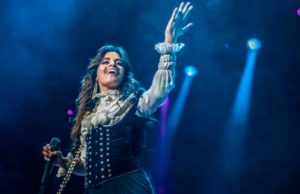
ddeb5fd06bccc2bf7a1e0cb9cf84590579482ecdr1-2048-758v2_hqCAMILA CABELLO CONTINÚA SUS TRIUNFOS EN PRESENTACION MEXICANA.”VIDEOS.

“Creo que nunca me he sentido tan feliz haciendo un concierto”, dijo en español Camila Cabello ex integrante del quinteto pop Fifth Harmony. La estrella pop estadounidenses nacida en Cuba, de padre mexicano y madre cubana, recordó los años que vivió de niña en México.

Camila Cabello debutó el lunes en escenarios mexicanos como solista con un concierto en el Palacio de los Deportes de la capital en el que estuvo acompañada por Noel Schajris, Jesse & Joy y su padre, con quien cerró con broche de oro cantando mariachi.

camilacabellomx-696x451CAMILA CABELLO CONTINUES ITS TRIUMPHS IN MEXICAN PRESENTATION.

Camila Cabello debuted on Monday in Mexican stages as a soloist with a concert at the Palacio de los Deportes in the capital where she was accompanied by Noel Schajris, Jesse & Joy and her father, with whom she closed with a gold flourish singing mariachi.

https://youtu.be/Mr0bG06yBU4

“I think I’ve never felt so happy doing a concert,” Camila Cabello, a former member of the Fifth Harmony pop quintet, said in Spanish. The American pop star born in Cuba, with a Mexican father and a Cuban mother, recalled the years she lived as a child in Mexico.

Agencies/AP/SinEmbargo/Internet Photos/YouTube/ Arnoldo Varona/ TheCubanHistory.com
THE CUBAN HISTORY, HOLLYWOOD.

logo

malecon