

COURTING THE CASTROS.
Washington Post Editorial Board February 21, 2015.
Publisher of US newspaper The Washington Post on the eve of the new round of talks between Cuba and the US, scheduled for February 27,015.
FOR ALL the high expectations, and deep anxieties, that surround the U.S.-Cuba thaw that President Obama announced two months ago, the reality is that the process is still in its very early days. The two countries have not agreed even on one of the simpler bilateral issues: opening full-fledged embassies in each other’s capitals. Cuban President Raúl Castro sounded an ominous note by hinting that complete normalization might depend on such far-fetched demands as the hand-over of the U.S. naval base at Guantanamo Bay or reparations for the U.S. embargo.
U.S. political leaders would be well advised not to succumb to, or foster, exuberance about the transformation in economic relations that might be at hand — much less about the pending transformation of the Cuban regime. Official contacts must not sugarcoat or lend undeserved legitimacy to a dynastic dictatorship that remains one of the most repressive on the planet.
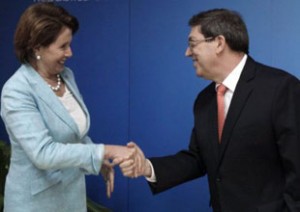
Consider the just-concluded visits to Havana by a House delegation led by Democratic leader Nancy Pelosi (Calif.) and a three-senator group made of Democrats Mark R. Warner (Va.), Amy Klobuchar (Minn.) and Claire McCaskill (Mo.) — the tone and tenor of which were too starry-eyed by half. Ms. Klobuchar gushed that she and her colleagues “walked freely around the streets and talked with anyone we wanted,” apparently oblivious to the political surveillance within which those “free” conversations occurred. Ms. McCaskill posted charming photos of vintage cars on her Instagram account; nothing depressing, like images of Cuba’s poverty, though.
Both delegations found time to meet with regime officials, including a prestige-enhancing sit-down with Vice President Miguel Díaz-Canel, Mr. Castro’s designated successor. Yet neither saw dissidents on the island, many of whom already feel understandably concerned that Mr. Obama negotiated with the Castro regime over their heads. Instead, the U.S. lawmakers met with unidentified “civil society” representatives. This contrasts with the trip last month led by Sen. Patrick Leahy (D-Vt.) , which did include a session with prominent regime opponents .
After that delegation left Cuba on Jan. 19, the government announced it would delay any more such visits for a while because of unspecified scheduling issues. The fact that the House and Senate groups arrived as planned, and did not see dissidents, suggested to some critics of the new policy an understanding that Capitol Hill’s access to the island now depends on avoiding dissidents — who, too, would gain prestige from meeting high-ranking Americans. All of the members of Congress deny such an arrangement and told us they brought up human rights with regime officials.
Yet the timing, and the appearances it created, should remind everyone that the Castro regime remains the gatekeeper to the island, leverage it can be counted on to use for every possible advantage, political or economic. No one, not even a politically powerful American visitor, is immune to being exploited by the Cuban propaganda machine; no one is truly free on that island. U.S. lawmakers need to understand that, fully, and behave accordingly.
CUBA PHOTOS.
CORTEJANDO A LOS CASTROS.
Washington Post Editorial Board Feb. 21, 2015.
Para todas las altas expectativas y ansiedades profundas que rodean el deshielo entre Estados Unidos y Cuba, anunciado hace dos meses por el presidente Obama, la realidad es que el proceso todavía está en sus primeros días. Los dos países no han acordado aún sobre uno de los asuntos bilaterales más simples: la apertura de embajadas de pleno derecho en sus respectivas capitales. El presidente cubano Raúl Castro lanzó una nota ominosa al insinuar que la normalización completa podría depender de tales demandas inverosímiles como la entrega de la base naval estadounidense de Guantánamo o las compensaciones por el embargo.
Los líderes políticos estadounidenses harían bien en no sucumbir ni apadrinar la exuberancia de la transformación en las relaciones económicas que podrían estar a la mano -y mucho menos acerca de la transformación pendiente del régimen cubano. Los contactos oficiales no deben endulzar o dar legitimidad inmerecida a una dictadura dinástica que sigue siendo una de las más represivas del planeta.
Considere las visitas que acaban de concluir a La Habana por una delegación de la Cámara de Representantes, encabezada por la líder demócrata Nancy Pelosi (California), y por un grupo de tres senadores demócratas Mark R. Warner (Virginia), Amy Klobuchar (Minnesota.) Y Claire McCaskill ( Missouri) -el tono y el tenor de las cuales fueron demasiado idealistas. La señora Klobuchar dijo efusivamente que ella y sus colegas “caminamos libremente por las calles y hablamos con quien queríamos”, aparentemente ajenos a la vigilancia política dentro de la cual transcurrieron esas conversaciones “libres”. La señora McCaskill publicó fotos encantadoras de autos antiguos en su cuenta de Instagram; nada deprimente incluyó, como imágenes de la pobreza de Cuba, sin embargo.
Ambas delegaciones encontraron tiempo para reunirse con funcionarios del régimen, incluyendo una enaltecedora reunión con el vicepresidente Miguel Díaz-Canel, sucesor designado del señor Castro. Sin embargo, ni los disidentes conocidos en la isla, muchos de los cuales ya se sienten comprensiblemente preocupados de que el señor Obama negociara con el régimen de Castro pasándoles por encima. En cambio, los legisladores estadounidenses se reunieron con representantes no identificados de la “sociedad civil”. Esto contrasta con el viaje realizado el pasado mes, liderado por el senador Patrick Leahy (D-Vermont), que sí incluyó una sesión con prominentes opositores al régimen.
Después de que la delegación salió de Cuba el 19 de enero, el gobierno anunció que retrasaría otras de esas visitas por un tiempo, debido a problemas de programación no especificados. El hecho de que los grupos de la Cámara de Representantes y del Senado llegaran como estaba previsto y no vieran disidentes, sugirió a algunos críticos de la nueva política un entendimiento de que el acceso del Capitolio a la isla depende ahora de evitar disidentes -que también ganarían prestigio reuniéndose con estadounidenses de alto rango. Todos los miembros del Congreso niegan tal arreglo y nos dijeron que discutieron el tema de los derechos humanos con funcionarios del régimen.
Sin embargo, el tiempo y las apariencias creadas deben recordar a todos que el régimen de Castro sigue siendo el guardián de la isla, y su influencia puede contar en el uso de todas las ventajas posibles, políticas o económicas. Nadie, ni siquiera un poderoso visitante político estadounidense, es inmune a ser explotado por la maquinaria de propaganda cubana; nadie es realmente libre en esa isla. Los legisladores estadounidenses deben entenderlo, plenamente, y comportarse en consecuencia.
Editorial del diario estadounidense The Washington Post en vísperas de la nueva ronda de conversaciones entre Cuba y EEUU, fijadas para el próximo 27 de febrero. Publicado el 21 de febrero de 2015.
The Cuban History, Hollywood.
Arnoldo Varona, Editor.