

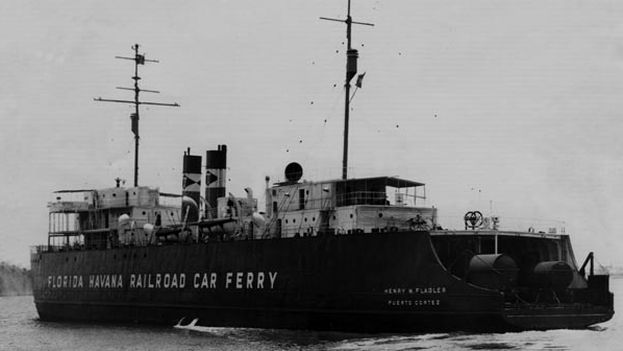
Maritime transport between Havana and Key West became very common in the early twentieth century until it was suspended in August 1961 as a result of the restrictions of the US embargo on the island. Now, the ghost of a ferry links the two sides has resurfaced following talks between the governments of Cuba and the United States.
José Manuel is 70 years old and over half his life has been spent fishing on the Malecon. For this retired, tanned skin and eyes that have seen almost everything is a dream spot again this ferry was going to Florida and he loved as a child. “The boys played to say goodbye and although I could never travel on it, my grandmother did themselves all the time.” Now, as evening falls, the septuagenarian waiting for a fish to pique the bait and before him, a sea without boats extends to infinity.
This week, the entrepreneur Brian Hall, who runs the company KonaCat based in Fort Lauderdale, made public his interest to operate ferry trips to Cuba from Marathon Marina, on Calle 11. Hall told the newspaper that he trusted digital KeysInfoNet to obtain free space for your catamaran, with capacity for 200 passengers and with which you plan to travel between the Florida Keys and Cuba twice daily.
The news has just reached the island, but since 17 December in Raul Castro and Barack Obama announced the process of restoring relations between the two countries, the return of the ferry has become a matter of relief for many nostalgic. A facilities economic and political strife that would bring this reconciliation between the two Governments, connect both countries with a maritime route would, in addition to its practical effects, a strong symbolism, say many.
Every great human work has something of madness, say older. The ferry service connecting Florida to Havana began with the efforts of a man. Henry M. Flagler, an oil tycoon who in 1886 founded the company Faster Florida East Coast Railway to build and operate the railroad of the east coast of Florida. Despite the great obstacles imposed by the geography of the keys and the constant danger of hurricanes, the madness of Flagler led him to trace the railways to Key West, where the service was inaugurated in January 1912. That work would be considered by many as the eighth wonder of the world, besides being the boldest infrastructure built exclusively at private expense.

Once the railroad was in Key West, somehow missing beat the distance to Cuba. Thus was born “the train moving through the water” as it is also called the ferry and whose service Havana-Cayo Hueso was inaugurated on January 5, 1915. The first shipment was made up a batch of refrigerated cars and boat It was named after Henry M. Flagler, a tribute to the visionary entrepreneur who had died two years earlier.
The release of products between both banks soared since then. In 1957 he came to carry more than half a million tons of goods in both directions, to which was added the movement of passengers and cars. The sea connection between the two sides would last 46 years and some remember it like yesterday the last ship had sailed.
“My grandmother frequently traveled to Florida on the ferry,” said Jose Manuel, who has had a bad day for fishing. “We were poor, but part of my family went there to work and sometimes returning on the same day,” he says wistfully. Near the fishing pole sitting on the wall of the Malecon, a teenager listens to the conversation and smiles incredulously. It is the generation that can not conceive that once the Malecon was not the barrier separating Cuba from the world but a connection point with the northern neighbor.
The string is taut and it seems that something has stung. José Manuel focuses on recovering the water that will be your dinner tonight, but despite its concentration reaches to say “the day you see the ferry coming back here, I can die in peace.
14YMedio, La Havana / ORLANDO PALMA / InternetPhotos / www.thecubanhistory.com
The Cuban History, Hollywood.
Arnoldo Varona, Editor.
CUBA PHOTOS.
CUBA-U.S. RELATIONS: EL BARCO (“FERRY”) QUE DIARIAMENTE UNIA U.S.- CUBA.
El transporte marítimo entre La Habana y Cayo Hueso llegó a ser muy común en la primera mitad del siglo XX hasta que fue suspendido en agosto de 1961 a consecuencia de las restricciones del embargo norteamericano sobre la Isla. Ahora, el fantasma de un ferri que enlaza las dos orillas ha vuelto a resurgir a raíz de las conversaciones entre los Gobiernos de Cuba y Estados Unidos.
José Manuel tiene 70 años y más de la mitad de su vida la ha pasado pescando en el Malecón habanero. Para este jubilado, de piel curtida y ojos que han visto casi todo, resulta un sueño el volver a divisar aquel ferri que iba a Florida y que tanto le gustaba cuando niño. “Los chiquillos jugábamos a decirle adiós y aunque nunca pude viajar en él, mi abuela sí lo hacía a cada rato”. Ahora, mientras cae la tarde, el septuagenario espera que algún pez pique la carnada y ante él, un mar sin embarcaciones se extiende hasta el infinito.
Esta semana, el empresario Brian Hall, que dirige la compañía KonaCat con sede en Fort Lauderdale, hizo público su interés de operar viajes a Cuba en ferri desde el puerto deportivo de Marathon, en la calle 11. Hall declaró al diario digital KeysInfoNet que confiaba en obtener espacio libre para su catamarán, con capacidad para 200 pasajeros y con el que planea viajar entre los Cayos de Florida y Cuba dos veces al día.
La noticia apenas ha llegado a la Isla, pero desde el 17 de diciembre pasado en que Raúl Castro y Barack Obama anunciaron el proceso de restablecimiento de relaciones entre ambos países, el regreso del ferri se ha convertido en un asunto de relieve para muchos nostálgicos. A las facilidades económicas y la distensión política que traería esta reconciliación entre los dos Gobiernos, conectar ambos países con una ruta marítima tendría, además de sus efectos prácticos, un fuerte simbolismo, aseguran muchos.
Toda gran obra humana tiene algo de locura, dicen los más viejos. El servicio de ferri que conectaba Florida con la capital cubana comenzó con el empeño de un hombre. Henry M. Flagler, un magnate petrolero que en el año 1886 fundó la compañía Florida Faster East Coast Railway para la construcción y explotación del ferrocarril de la costa este de Florida. A pesar de los grandes obstáculos que imponía la geografía de los cayos y el peligro constante de huracanes, la locura de Flagler lo llevó a trazar las líneas ferroviarias hasta Cayo Hueso, donde quedó inaugurado el servicio en enero de 1912. Aquella obra sería considerada por muchos como la octava maravilla del mundo, además de ser la infraestructura más intrépida construida exclusivamente con fondos privados.
Una vez que el ferrocarril estuvo en Cayo Hueso, faltaba vencer de alguna manera la distancia hacia Cuba. Así fue como nació “el tren circulando por las aguas” como se le llamó también al ferri y cuyo servicio La Habana-Cayo Hueso quedó inaugurado el 5 de enero de 1915. El primer cargamento estaba compuesto por un lote de vagones refrigerados y la embarcación recibió el nombre de Henry M. Flagler, en homenaje al emprendedor visionario que había muerto dos años antes.
El despacho de productos entre ambas orillas creció vertiginosamente a partir de ese momento. En 1957 se llegó a transportar más de medio millón de toneladas de mercancías en ambos sentidos, a lo que se le sumaba el trasiego de pasajeros y autos. La conexión por mar entre las dos orillas duraría 46 años y algunos lo recuerdan como si ayer mismo hubiera zarpado el último barco.
“Mi abuela viajaba frecuentemente a Florida en el ferri”, explica José Manuel, que ha tenido un mal día para la pesca. “Éramos pobres, pero parte de mi familia iba allá a trabajar y a veces regresaban en el mismo día”, asegura con nostalgia. Cerca de la caña de pescar, sentado sobre el muro del Malecón, un adolescente escucha la conversación y sonríe con incredulidad. Es de la generación que no puede concebir que alguna vez el Malecón no fuera la barrera que separaba Cuba del mundo, sino un punto de conexión con el vecino del norte.
El cordel se tensa y parece que algo ha picado. José Manuel se concentra en recuperar del agua la que va a ser su cena de esta noche, pero a pesar de su concentración alcanza a decir “el día que vea ese ferri de nuevo llegando aquí, ya me puedo morir tranquilo.
14YMedio, La Havana / ORLANDO PALMA / InternetPhotos / www.thecubanhistory.com
The Cuban History, Hollywood.
Arnoldo Varona, Editor.