

On May 17, 1900 winter tournament was resumed with the launch of the General League Baseball on the island of Cuba. Four teams, Havana, San Francisco, Cuban and Almendares, summoned the best in the sport base in the nation, not only to welcome the arrival of a new century but also a flourishing stage in Creole ball, definitely plunge the Cuban circuit in the professional market.
During this period there was the final leap of Cuban players to the majors. In Rafael Almeida and Armando Marsans fell the honor of being the first figures to venture into the U.S. major leagues in 1911, and even in these early days the road was opened only for men with light skin, after the color barrier broken 1947 was very well traveled by many compatriots.
Another significant turning point in League history came after the building of the second Almendares Park in 1919, located on the site today still holds the bus terminal in the capital. Although, here the sacrifice given by the honor beisbolístico was painful, because until football came to displace the public interest the winter circuit. They were difficult times, which played in the morning to the ball and had to leave the field ready for that afternoon they did the players. All this happened before the second Almendares Park closed its doors forever in 1929.
With the opening of La Tropical stadium during the 1930-31 championship, next to the brewery of the same name, began the golden age of Cuban baseball governing body. A new space of time that was fed a rampant increase of fanaticism in the stands, the continued support of American players and the emergence of new values Cubans. Larger years, despite always stains. It was there where he developed the first night game on December 21, 1937.
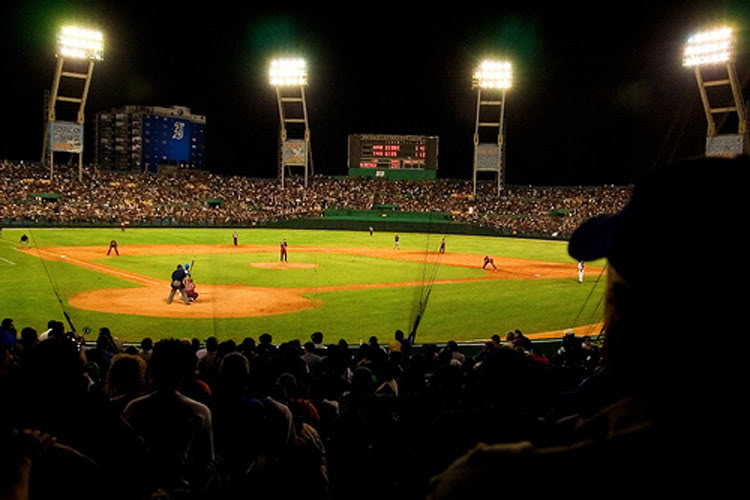
In the park tropicalino the crowd back to life one day those emotions that were weakened, and made those who were thinking that it was time to build a new facility that could accommodate the thousands of proselytes who crowded the diamond brewer. Thus, with some drawbacks construction, the tournament of 1946-47 opened the Grand Stadium del Cerro on October 26, 1946.
Precisely, in the year of 1946 had entered the Florida International League (Class C) the Havana Cubans, a squad made up mostly of Cuban athletes. This event officially sealed the entrance to the Island in organized baseball in the United States. However, the same date of the above facts, the explosion of the conflict between Mexican billionaire Alfonso Pasquel and Major League Baseball.
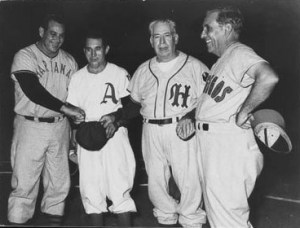 Izq.a Der. Napoleon Reyes/Conrado Marrero/ Adolfo Luque/Oscar Rodriguez.
Cuban winter ball did not escape the influence of this dispute. Among the contests of 1946-47 and 1947-48 winter season suffered the disorder of the division. On the one hand, those loyal to the pact with the Yankees (Cuban League Professional Baseball) Stadium on the Hill, the other, rebels (National League of the Federation), the Estadio La Tropical. Two different campaigns, two simultaneous events and unforgettable moment.
The survivors of that event said they always got independent enormous popularity, but the project suffered from many shortcomings and uncontrolled selfishness that led to his immediate failure. The signing of the armistice that ended hostilities in 1949, left as the only alternative the regular League race at the Gran Stadium and gave a second wind with the formation of the Confederation of the Caribbean, joined under its statutes to players from Cuba , Venezuela, Puerto Rico and Panama, and instituted a club tournament champions among members of the coalition called the Caribbean Series.
The enormous success of this partnership and the celebrity that quickly reached the Caribbean series, contributed to the entry of the 50’s the League managed to lift the spirits of “respectable” throughout the archipelago. It also favored the consolidation of work a balanced competition between the four teams. It was not only beat the Almendares or Habana, but the Marianao and Cienfuegos became winners.

All this made within fifty splendor to the famous Cuban circuit, although it was vitally having established a system of six games per week, in the country to have a stadium of similar status to that of the Great leagues, the unprecedented growth that took the game among women and enjoy baseball and widely disseminated by the press coverage, radio and television the newly released, without forgetting also the flourishing tourism and economy of the nation at that time.
But the triumph of the Revolution Fidel Castro surprised everyone when he was disputing the contest of 1958-59. In its rush reformist, revolutionary changes also caught the baseball. After some challenges developed in cities and towns of central and east of the island in the early 60’s, began to clamor for an extension of the timetable to offer, so regulated, comprehensive programs outside the capital of the Republic.
On the other hand, from the East squad claimed a representative of that area. Exposed as the main argument that such a large audience and enthusiastic as the eastern deserved the attention of the League. The idea came to take a shade of immediate plan, declaring Mr. Alfred Small, owner of Mariano, who was willing to transfer the franchise and rename it with the name of Eastern Tigers and if, moreover, the owners of Cienfuegos seconded it and Elephants moved her to the city of Santa Clara, could have been playing alternate weekends in these two provinces would have been very positive and make the most games in the East.
With this scheme, the Cuban winter championship would become more representative and a final territorial nature of national competition, much needed items that show for its first eighty years of existence. However, the project was only in the attempt. On February 7, 1961 was formally disbanded the Cuban League of Professional Baseball (LCBP) by the Government of Fidel Castro.
Sources:DesdeMiPalco/Manzano/ InternetPhotos/TheCubanHistory.com
Professional Baseball (1900-1961)/ The Cuban History/ Arnoldo Varona, Editor
BASEBALL PROFESIONAL (1900-1961)
El 17 de Mayo de 1900 se reanudó el torneo invernal con el despegue de la Liga General de Baseball de la Isla de Cuba. Cuatro equipos, Habana, San Francisco, Cubano y Almendarista, convocaron a los mejores exponentes del deporte Base en la nación para, no sólo darle la bienvenida a la llegada de un nuevo siglo, sino también a una floreciente etapa en la pelota criolla que, definitivamente, sumergiría al circuito cubano en el mercado profesional.
Durante este período se produjo el salto definitivo de los peloteros cubanos hacia las Grandes Ligas. En Rafael Almeida y Armando Marsans recayó el honor de ser las primeras figuras en incursionar en las Ligas Mayores de Estados Unidos en 1911, y aunque en estos primeros tiempos la senda sólo se abrió para hombres de piel clara, luego de rota la barrera racial en 1947 fue muy bien transitada por numerosos compatriotas.
Otro significativo punto de giro en la historia de Liga se registró luego con la edificación del segundo Almendares Park en 1919, ubicado en el sitio que todavía ocupa hoy la Terminal de Ómnibus en la capital del país. Aunque, aquí el sacrificio entregado por el honor beisbolístico resultó doloroso, pues hasta el balompié llegó a desplazar del interés del público el circuito invernal. Fueron momentos difíciles, en que se jugaba por la mañana a la pelota y había que dejar el campo preparado para que en horas de la tarde lo hicieran los futbolistas. Todo esto ocurrió antes de que el segundo Almendares Park cerrara sus puertas para siempre en 1929.
Con la inauguración del estadio La Tropical durante el campeonato de 1930-31, junto a la cervecería del mismo nombre, comenzó la era dorada del máximo organismo beisbolero cubano. Un nuevo espacio de tiempo que se alimentó de un incremento desenfrenado del fanatismo en las tribunas, de la continua asistencia de peloteros norteamericanos y de la aparición de nuevos valores cubanos. Los años más grandes, a pesar de las manchas de siempre. Fue justamente allí donde se desarrolló el primer partido nocturno el 21 de diciembre de 1937.
En el parque tropicalino la multitud devolvió a la vida aquellas emociones que un día se debilitaron, e hizo pensar a quienes debían, que ya era hora de fabricar una nueva instalación que pudiera albergar a los miles de prosélitos que abarrotaban el diamante cervecero. Así, con algunos inconvenientes constructivos, el torneo de 1946-47 estrenó el Gran Stadium del Cerro el 26 de Octubre de 1946.
Justamente, en ese año de 1946 habían ingresado en la Liga Internacional de Florida (Clase C) los Havana Cubans, una escuadra constituida en su mayoría por atletas cubanos. Este acontecimiento selló oficialmente la entrada de la Isla en el béisbol organizado de los Estados Unidos. Empero, coincidente en fecha con los anteriores hechos, se produjo la explosión del conflicto entre el millonario mexicano Alfonso Pasquel y el Béisbol de Ligas Mayores.
La pelota invernal cubana tampoco escapó a la influencia de esta disputa. Entre las contiendas de 1946-47 y 1947-48 la temporada invernal sufrió el trastorno de la división. De una parte, los leales al pacto con los yanquis (Liga Cubana de Baseball Profesional) en el Stadium del Cerro, del otro, los rebeldes (Liga Nacional de la Federación), en el Estadio La Tropical. Dos campañas diferentes, dos certámenes simultáneos y un instante inolvidable.
Izq.a Der. Napoleon Reyes/Conrado Marrero/ Adolfo Luque/Oscar Rodriguez.
Los sobrevivientes de aquel evento independiente siempre afirmaron que consiguió enorme popularidad, pero también el proyecto padeció de numerosos defectos y egoísmos incontrolados que determinaron su fracaso inmediato. La firma del armisticio que puso fin a las hostilidades en 1949, dejó como única alternativa la contienda regular de la Liga en el Gran Stadium y ofreció un segundo aire con la formación de la Confederación del Caribe, que afilió bajo sus estatutos a peloteros de Cuba, Venezuela, Puerto Rico y Panamá, e instituyó un torneo de clubs campeones entre los miembros de la coalición denominada Serie del Caribe.
El éxito que logró esta alianza y la celebridad que rápidamente alcanzaron las series caribeñas, coadyuvó a que con la entrada de la década del 50 la Liga lograra levantar el ánimo del “respetable” por todo el archipiélago. También favoreció la consolidación del trabajo una equilibrada rivalidad entre sus cuatro equipos. Ya no sólo se vio vencer al Habana o al Almendares, sino que el Marianao y el Cienfuegos se convirtieron en ganadores.
Todo esto hizo de los cincuenta un lapso de esplendor para el célebre circuito cubano, aunque también fue vital el hecho de tener establecido un sistema de seis partidos por semana, de poder contar en el país con un estadio de categoría similar a los de las Grandes Ligas, del auge sin precedentes que tomó el juego entre la población femenina y de gozar el béisbol de una amplia difusión y cobertura informativa por la prensa, la radio y la recién estrenada televisión, sin obviar además, el florecimiento turístico y económico de la nación en ese tiempo.
Pero el triunfo de la Revolución de Fidel Castro sorprendió a todos cuando se disputaba el concurso de 1958-59. En su avalancha reformista, los cambios revolucionarios también atraparon al béisbol. Luego de algunos desafíos desarrollados en ciudades y pueblos del centro y oriente de la Isla a principios de los 60, se comenzó a clamar por una extensión del calendario para ofrecer, de modo reglamentado, programas completos fuera de la capital de la República.
Por otro lado, desde Oriente se reclamaba una escuadra representativa de aquella zona. Exponían como principal argumento que un público tan numeroso y entusiasta como el oriental merecía la atención de la Liga. La idea llegó a tomar cierto matiz de plan inmediato, al declarar el señor Alfredo Pequeño, propietario del Marianao, que estaba dispuesto a trasladar la franquicia y rebautizarla con el nombre de Tigres de Oriente y si, además, los dueños del Cienfuegos lo secundaban y trasladaban sus Elefantes hacia la ciudad de Santa Clara, se hubiera podido jugar los fines de semana alternos en esas dos provincias y habría sido muy favorable efectuar la mayor cantidad de partidos en el Este del país.
Con tal esquema, el campeonato invernal cubano hubiese adquirido mayor representatividad territorial y un definitivo carácter de certamen nacional, elementos que tanto necesitó el espectáculo por sus primeros ochenta años de existencia. Sin embargo, el proyecto sólo quedó en el intento. El 7 de Febrero de 1961 fue formalmente desintegrada la Liga Cubana de Baseball Profesional (LCBP) por el Gobierno de Fidel Castro.
Sources:DesdeMiPalco/Manzano/ InternetPhotos/TheCubanHistory.com
Professional Baseball (1900-1961)/ The Cuban History/ Arnoldo Varona, Editor